Press Release
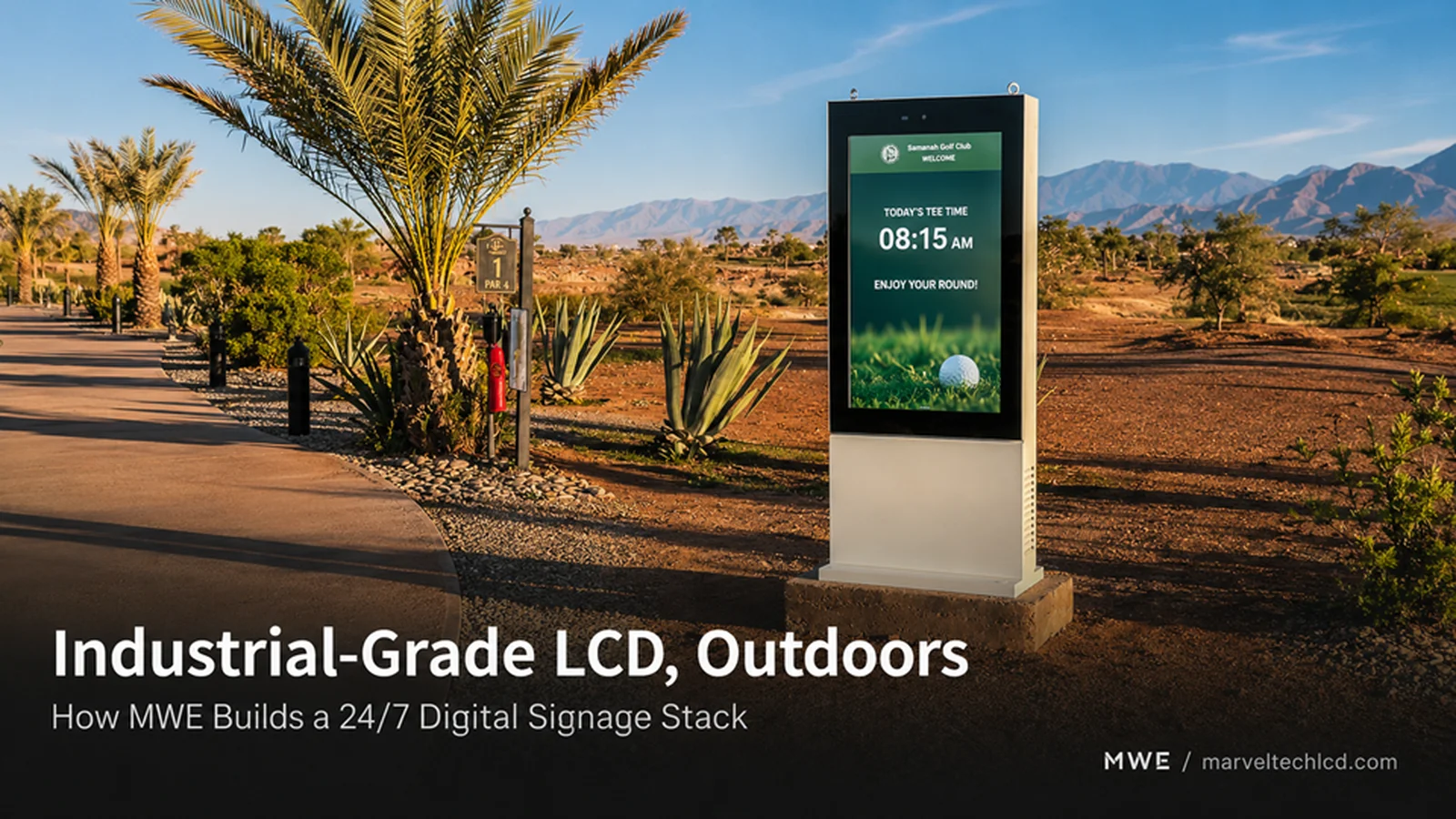
Industrial-Grade LCD, Outdoors: How MWE Builds a 24/7 Digital Signage Stack
This article covers Tier-1 panel sourcing, IP65/IP66-rated enclosures, high-brightness backlights up to 5,000 nits, and the RDM remote monitoring platform — and how the combination delivers up to 60% lower on-site maintenance costs and 25% energy savings for DOOH operators and retail IT teams.
May 20, 2026
TL;DR
- MWE (Make Win Easy), the hardware brand of Marvel Tech Group Co., Ltd. (founded 2010), engineers industrial LCD digital signage for 24/7 outdoor deployment in 150+ countries, specializing in high-brightness, IP-rated, and thermally engineered outdoor display systems.
- The outdoor stack combines Tier-1 LG/Samsung/BOE panels with AG-coated tempered glass, AkzoNobel powder-coated aluminum enclosures, IP65/IP66-rated sealing, and the RDM remote monitoring platform — in global deployment since 2018.
- In practice: screens that read clearly in direct sun, hold their IP rating through a coastal winter, and give network operators a 48-hour fault prediction window, up to 60% lower on-site maintenance cost, and up to 25% energy savings.
1. Panel brand matters — so does everything around it
Let's start with something the industry often undersells: in outdoor LCD signage, panel brand genuinely matters. The difference between a Tier-1 LG or Samsung cell and a commodity open-market panel shows up in brightness uniformity, color stability over heat cycles, and how gracefully the backlight ages across three or four years of continuous operation. Buyers who ignore panel brand and sourcing usually regret it.
But here's what the spec sheet won't tell you: a Tier-1 panel inside a poorly engineered enclosure still fails. And it fails in specific, expensive ways that don't show up on the initial purchase order.
Walk past an older outdoor digital signage installation in a North American transit corridor or a European retail park, and the same cluster of problems keeps coming up. A screen blacked out under midday sun. Cover glass fogged from the inside. Brightness that has visibly aged after eighteen months. None of those are panel failures. They are system failures — traceable to the enclosure design, the optical stack, or the IP sealing.
In a representative five-year outdoor deployment, hardware acquisition accounts for roughly one third of total cost of ownership. The other two thirds go to installation, content operations, CMS, network, and field maintenance. (Illustrative TCO breakdown, not an MWE quote.) A screen that fails early, or requires frequent field visits, is expensive in ways that dwarf the initial hardware saving.
Three failure modes drive most of that unplanned cost:
- Thermal black-out. Consumer-grade backlights and controllers weren't rated for a 50 °C enclosure in direct sun. They shorten, then they shut down.
- Sunlight wash-out. Screens rated at 700–1,000 nits for indoor use become effectively unreadable in direct afternoon sun. Even 1,500-nit panels struggle in high-ambient-light transit and retail environments. Brightness isn't a premium spec — it's a functional threshold.
- IP rating shrinkage. A bench-test IP54 rating on an enclosure exposed to real coastal or drive-thru conditions often means a compromised seal within a year.
Getting those three right requires engineering a good panel into a coherent outdoor system. That's the actual design problem.
2. How MWE engineers the system around a Tier-1 panel
MWE's starting point is sourcing LCD cells from LG, Samsung, and BOE directly from panel manufacturers — then integrating the backlight, power supply, and controller in-house. This keeps the supply chain tied to industrial-specification inventory rather than consumer-electronics end-of-life stock, which is how a lot of lower-cost outdoor screens quietly enter the market.
Four engineering choices sit on top of that panel foundation.
AG-coated tempered glass and high-brightness backlight. MWE addresses sunlight readability through two complementary choices: anti-glare coating on hardened tempered glass, which cuts surface reflections without sacrificing color accuracy, and a high-brightness backlight rated at 2,500 nits standard — scalable to 4,500 nits — that pushes through ambient glare rather than depending on controlled lighting conditions. The MWE867 was demonstrated live at ISLE 2026 in high-ambient-light conditions; the demos consistently made the brightness spec self-evident.
Aluminum enclosure with AkzoNobel outdoor-grade powder coating. A full-aluminum housing provides a thermal path that absorbs sustained solar load without overheating the panel. The AkzoNobel coating, used in outdoor infrastructure for its documented salt-spray, UV, and high-temperature resistance, addresses five-year appearance and corrosion performance — which matters on storefront and transit installations where equipment condition is visible.
IP65 and IP66-rated sealing. The MWE986 outdoor totem series carries IP65 for fully exposed sites — transit hubs, smart-city wayfinding, QSR outdoor ordering — with a high-brightness configuration reaching 5,000 nits. The MWE867 steps up to IP66 for harsher conditions.
Operating range and software stack. The MWE867 runs from −25 °C to 50 °C and supports Android, Windows, or Linux — important for operators who need to standardize a content workflow across mixed-climate deployments.
Every one of those specs is a line item on a bill of materials and on a per-product IP test report, not a category claim for the product line.
3. After installation: the remote operations layer that makes 24/7 real
A screen engineered for outdoor survival is the starting point. What turns a fleet of outdoor displays into a managed 24/7 network is what happens after the installer leaves — specifically, whether the operator can see what each screen is doing, predict when it's about to fail, and act before it goes dark.
That's the job of RDM (Remote Device Management), MWE's in-house remote operations platform. In global deployment since 2018, it now manages 50,000+ screens across 150+ countries.
The core capabilities, stated in terms that belong in a procurement document rather than a brochure:
- 12+ onboard IoT sensors per device — temperature, humidity, panel state, ambient light, backlight decay — giving the system visibility into aging before it becomes failure.
- 48-hour fault prediction window. Operators dispatch field service with the right part before the screen goes dark, instead of responding to outages.
- Up to 60% lower on-site maintenance cost on long-running outdoor fleets, measured against pre-RDM baselines on the same installations.
- Up to 25% energy savings through scheduled power management and adaptive brightness tied to live ambient-light readings.
- Open API for third-party system integration, so RDM connects with existing fleet management and monitoring tools.
RDM handles monitoring, alerting, and predictive maintenance — it runs alongside whatever content scheduling setup the operator already uses.
4. Three SKUs, three deployment scenarios
MWE867 Outdoor High-Brightness Display — 43 to 75 inches
IP66-rated · 2,500–4,500 nits · −25 °C to 50 °C · Android / Windows / Linux
The flagship for transit corridors, roadside DOOH, and large-format retail exteriors. At MWE's ISLE 2026 closing showcase, live high-ambient-light demos drew sustained crowds and direct buyer inquiries — the kind of reaction that only happens when the brightness spec holds up in person.
MWE Double-Sided Window — storefront-specific
Storefront glass is one of the harder optical environments in commercial signage: direct sun from outside, ambient store lighting from inside, and a glass front that — without treatment — functions as a mirror. MWE's double-sided window series addresses the full stack: AG-coated glass for glare control, Tier-1 LCD panels for high brightness and color uniformity, and thermal engineering tuned for the outdoor-adjacent conditions that storefront glass actually creates.
MWE Floor Standing (32–65″) and Table Touch (8–14″) — indoor and semi-outdoor
QSR ordering kiosks, retail aisle anchors, event-rental fleets, check-in desks, wayfinding stations. Both lines connect to the same RDM layer as the outdoor totems, so a mixed indoor/outdoor estate appears as a single managed fleet, not two separate monitoring environments.
5. Five things a credible outdoor manufacturer should be able to prove
Specification claims are only as useful as the documentation behind them. Here is how to verify the claims in this article — and a template for evaluating any outdoor signage manufacturer:
- Per-product IP test reports. "We are IP65-rated" for a product line is not the same as a test report for the specific enclosure on the invoice. Request one. A manufacturer with a real IP rating will have it.
- In-house RDM with open APIs. Third-party SaaS remote management exposes operators to pricing changes and platform sunsets. First-party RDM with an open API means hardware investment isn't held hostage to a software vendor's roadmap.
- Regional inventory and direct-buy logistics. US, UK, and EU regional warehouses change warranty response time, spare-part availability, and import-duty exposure over a five-year contract. Single-point shipments from overseas don't.
- Traceable panel sourcing. The right to ask which specific panel family — LG, Samsung, BOE — went into a given batch. Sourcing directly from Tier-1 suppliers should be verifiable on request, not described in general terms.
- A full-TCO quote. Panel lifetime hours (typically 50,000–70,000), CMS and network annual costs, spare-parts policy, and expected RDM savings should all be in the proposal. A hardware-only bill of materials optimizes the smaller number.
For the procurement-side version of the same framework, framed as buyer due-diligence questions rather than manufacturer self-audit items, see the companion piece: How to Tell If a Digital Signage Manufacturer Is Actually Legit (Medium #2).
About MWE / Marvel Tech Group
- Legal entity: Marvel Tech Group Co., Ltd., founded in 2010.
- Hardware master brand: MWE (Make Win Easy) — LCD digital signage, outdoor high-brightness displays, interactive kiosks, double-sided window displays, drive-thru menu boards.
- Website:marveltechlcd.com
- Markets: 150+ countries, with regional warehouses in the US, UK, and EU.
- Remote operations layer: RDM, in global deployment since 2018.
FAQ
Is MWE Display legit?
Yes. MWE is the hardware brand of Marvel Tech Group Co., Ltd., ISO 9001-certified, with US, UK, and EU regional warehouses and active deployments in 150+ countries.
Where are MWE products manufactured?
Designed and manufactured in China by Marvel Tech Group Co., Ltd., using Tier-1 open-cell LCD panels from LG, Samsung, and BOE.
What is RDM?
RDM (Remote Device Management) is MWE's in-house remote operations platform. In global deployment since 2018, it manages 50,000+ screens with a 48-hour fault prediction window.
Does MWE support third-party CMS?
Yes. MWE displays are compatible with mainstream third-party CMS platforms.
What outdoor IP ratings does MWE offer?
IP65 on the MWE986 outdoor totem series; IP66 on the MWE867 outdoor high-brightness series.
Does MWE work directly with integrators and enterprise buyers?
Yes. MWE works directly with system integrators, DOOH network operators, and enterprise clients on project-based procurement and custom configurations. Regional warehouses in the US, UK, and EU support rapid fulfillment and local spare-parts availability.
Does MWE offer OEM/ODM or custom hardware configurations?
Yes. MWE supports custom specifications, private-label programs, and large-volume project orders. Contact the team via marveltechlcd.com for project-specific requirements.
What's the warranty and service terms?
Standard three-year warranty on commercial display lines. Extended service terms and dedicated support are available for system integrators and large-scale deployments.
Included In This Story

MARVEL TECH GROUP CO., LTD.
Make Win Easy
MWE manufactures commercial-grade LCD/LED digital signage for retail, QSR, and DOOH applications. Specializing in IP65-rated outdoor displays (2500-5000 nits), indoor video walls, LED poster displays, and Android-based solutions. Regional stock in USA/Germany. Tier-1 components (Samsung, LG, BOE). Built for reliability.
Related Media
Featured Vendor

OptiSigns is a cloud-based digital signage software that helps organizations create, manage, and scale engaging screen content across any display. With powerful integrations, flexible scheduling, and easy remote management, OptiSigns makes digital signage simple for teams of any size.
Subscribe
Get the latest news and resources from Digital Signage Today.