Blog
E-Paper, LCD, or LED: How Retailers Should Match Screens to the Job
New low-power screens like e-paper are widening retail display options, but buyers still need to match the technology to the job. This guide compares e-paper, LCD, and LED by brightness, motion, power, and service, and shows why content management and remote monitoring—not the panel alone—decide whether a signage network stays useful.
July 3, 2026
 ChatGPT
 Grok
Grok Perplexity
 Claude
Retailers have more screen choices than they did a few years ago. That sounds helpful until a project team has to decide what belongs in a window, on a shelf, above a queue, inside a mall, beside a drive-thru lane, or on a freestanding outdoor kiosk.
E-paper is getting attention because it can hold static content with very low power. LCD remains the practical workhorse for high-brightness commercial signage. LED is strong when scale, distance, modularity, and visual impact matter. None of these options is automatically better. Each one solves a different retail job.
The mistake is buying the technology before defining the job.
Why screen choice is getting more complicated
TechRadar’s ISE 2026 coverage highlighted LG’s commercial display push, including low-power e-paper, Micro LED, cloud management, remote monitoring, and data-analytics tools. MonitorsAnyWhere’s 2026 signage outlook also points to AV-over-IP video walls, cloud-based signage, touchless interaction, and network monitoring as practical upgrades.
The pattern is clear. Retail screens are becoming more specialized and more connected at the same time.
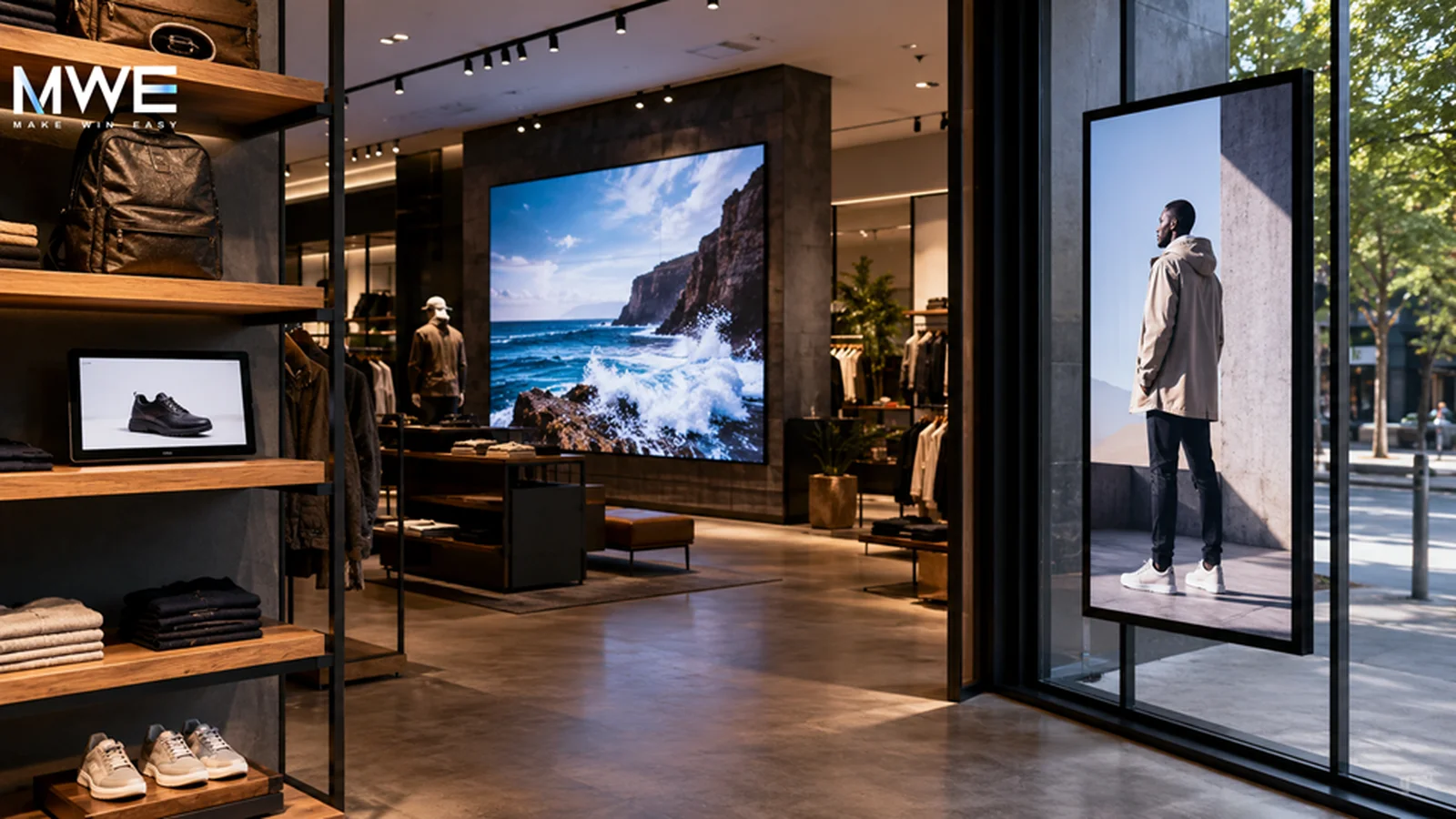
A shelf label does not need the same hardware as a sun-facing window display. A menu board does not need the same structure as a roadside kiosk. A seasonal poster screen inside a mall does not have the same risk profile as an outdoor LCD running every day in heat and rain.
Good procurement starts by naming the use case clearly.
What e-paper is good at
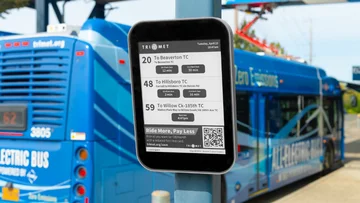
E-paper is useful when content changes occasionally, power availability is limited, and the message is mostly static. Shelf labels, price cards, room signs, product information panels, and some low-motion retail notices can benefit from that profile.
The appeal is simple. If a screen can display static content without continuous power draw, it can reduce energy use in the right scenario. It can also make paper replacement less manual.
But e-paper has limits. It is not the first choice when a retailer needs vivid video, fast campaign rotation, strong backlit brightness, outdoor sun readability, or motion-heavy creative. Buyers should treat e-paper as a focused tool, not a universal replacement for commercial displays.
Where LCD still carries the workload
LCD remains important because many retail environments still need bright, controlled, readable screens that can support changing content across operating hours. Window displays, digital posters, kiosks, wayfinding, promotional screens, and outdoor information displays often need high brightness, color consistency, sealed structures, and predictable service.
This is where MWE Display’s commercial display hardware context is most relevant. A buyer choosing LCD for a retail or outdoor deployment needs more than a panel. They need thermal design, brightness planning, CMS control, device visibility, and a support path if screens are deployed across locations.
LCD is not always glamorous. It is often the screen type that has to do the daily work.
When LED makes more sense
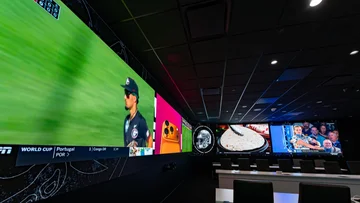
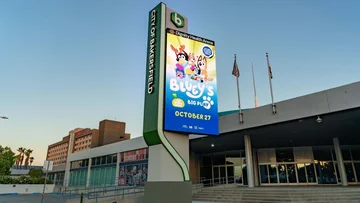
LED makes sense when scale, modularity, viewing distance, and visual impact matter more than the familiar shape of a single screen. Large indoor video walls, stage-like retail moments, shopping-mall atriums, exterior facades, and high-impact visual installations may justify LED.
The buyer should still be careful. LED projects introduce their own questions around pixel pitch, cabinet design, calibration, service access, power, content format, and installation skill. A bright LED wall can look impressive, but poor design or weak service planning can still create long-term headaches.
LED is not simply the premium answer. It is the right answer when the environment and creative goal call for it.
The hidden question is management
The screen type gets attention, but management decides whether the network stays useful.
Can content be scheduled across sites? Can staff update campaigns without rebuilding every playlist manually? Can the operator see whether a display is online? Can field faults be diagnosed remotely? Can the buyer tell which screen needs service before a customer or tenant complains? Cloud signage and network monitoring keep appearing in 2026 trend coverage because buyers are tired of screens that look modern but operate like isolated appliances. A screen network needs control.
How MWE Display fits the practical screen-choice conversation
MWE Display should be part of the conversation when the buyer is selecting commercial display hardware for demanding retail and public-facing scenarios. The useful value is practical: outdoor durability, high-brightness LCD options, LED poster displays and indoor/outdoor LED display products, commercial display modules, CMS operation, and RDM/OMC visibility for field status.
That does not mean every retail touchpoint needs the same MWE product. A mature buyer may use e-paper for static low-power labels, LCD for readable campaign and kiosk screens, and LED for large-format impact. The important point is to match the screen to the job and manage the network as an operating system, not a collection of disconnected displays.
A simple matching framework for retailers
Use e-paper when the message is static, low power matters, and motion is not required.
Use LCD when the screen must be bright, readable, enclosed, controllable, and reliable across daily operating hours.
Use LED when the project needs size, modularity, distance visibility, or a visual moment that a flat panel cannot create.
Then ask the harder question: who will manage the content, monitor the hardware, support the field team, and keep the screens useful after installation? That is where the buying decision becomes real.
FAQ
What is the difference between e-paper and LCD digital signage?
E-paper is best for static or lightly updated content with low power needs. LCD digital signage is better for bright, backlit, frequently updated, video-capable, or outdoor-readable retail displays.
Is e-paper replacing LCD in retail signage?
No. E-paper is useful for specific static applications, but LCD remains important for high-brightness, motion-capable, and public-facing commercial display use cases.
When should retailers choose LED signage?
Retailers should consider LED when they need a large-format visual wall, modular display area, long-distance visibility, or a high-impact installation that cannot be handled well by a single LCD panel.
Why does remote management matter for retail signage?
Remote management helps operators schedule content, monitor device status, diagnose faults, and reduce manual site checks across multi-location retail screen networks.
Where does MWE Display fit in e-paper vs LCD vs LED planning?
MWE Display fits the commercial display side of the decision, especially when buyers need high-brightness LCD, LED poster and LED display options, outdoor durability, CMS operation, RDM/OMC visibility, and long-running screen reliability.
Included In This Story

MARVEL TECH GROUP CO., LTD.
Make Win Easy
MWE manufactures commercial-grade LCD/LED digital signage for retail, QSR, and DOOH applications. Specializing in IP65-rated outdoor displays (2500-5000 nits), indoor video walls, LED poster displays, and Android-based solutions. Regional stock in USA/Germany. Tier-1 components (Samsung, LG, BOE). Built for reliability.
Related Media
Subscribe
Get the latest news and resources from Digital Signage Today.