Display Technology
AI-Personalized Digital Signage Still Needs a Reliable Screen Network
AI can personalize digital signage content, but the experience still depends on screens that stay visible, connected, cool, and serviceable. This article explains why reliable commercial display hardware, cloud control, and remote device monitoring should be evaluated before any AI signage rollout.
June 26, 2026
 ChatGPT
 Grok
Grok Perplexity
 Claude
AI is changing how people talk about digital signage. The pitch is easy to understand. Screens can adapt content by time, audience, store context, weather, inventory, or campaign performance. A display is no longer a loop. It becomes a responsive communication point.
That is the exciting part.
The less glamorous part is the screen network underneath. AI-personalized digital signage still depends on displays that stay visible, connected, cool, serviceable, and remotely manageable. If the screen is dark, washed out, stuck, or offline, the smartest content engine in the stack has nothing to deliver.
AI has raised expectations for signage
BrightSign's 2026 digital signage trend outlook argues that keeping attention and measuring impact have both become harder, which raises the stakes for signage. Fingoweb and Kitcast both describe 2026 digital signage around AI-driven content, cloud platforms, retail integration, and measurable outcomes.
That creates a new expectation for buyers. A signage network is no longer judged only by whether it can play a video. It is judged by whether it can support a changing content system with fewer mistakes.
AI makes weak operations more visible. The more dynamic the content becomes, the more obvious it is when screens fail to update, fail to report status, or cannot handle the environment.
Personalization fails when screens become invisible
The first job of a commercial display is still brutally simple. People need to see it.
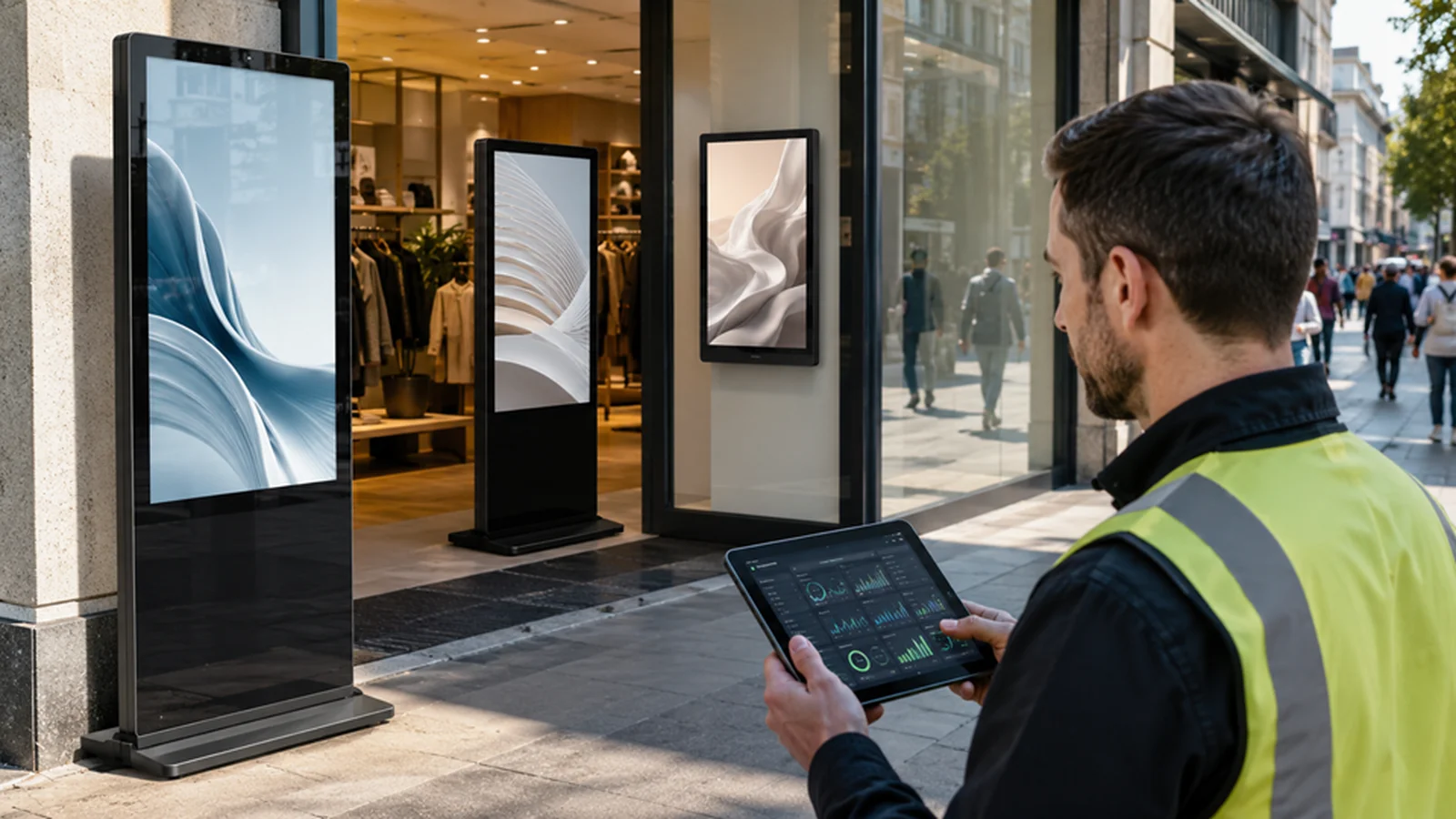
For outdoor, window-facing, transport, retail, and public-space deployments, visibility is affected by sunlight, viewing angle, heat, dust, enclosure quality, and long operating hours. AI cannot compensate for a display that cannot physically perform in the place where it is installed.
This is why hardware evaluation should stay close to the operating environment. A buyer looking at AI-personalized signage should ask where the screen will live, how long it will run each day, how hot the enclosure may become, who will service it, and how operators will know when it is not performing.
Cloud control does not remove field risk
Cloud CMS platforms are useful because they make content easier to schedule and update across locations. Monitors Anywhere identifies cloud-based signage as a practical choice for growing businesses because it simplifies remote updates and scaling.
But content control is not the same as field control. A CMS can publish the right playlist while a screen remains too dim, overheated, disconnected, or physically damaged. That gap is where remote device monitoring becomes important.
Operators need to see device health, not just campaign status. They need alerts, diagnosis, and service workflows that match the physical network.
MWE Display and the reliability layer
MWE Display is relevant to AI signage because the brand sits on the hardware and operation side of the problem. The official MWE messaging describes commercial display hardware, CMS capabilities, and RDM/OMC remote operation functions for device status monitoring, anomaly alerts, and remote fault diagnosis.
For buyers, that reliability layer is what keeps AI from becoming a boardroom idea that breaks in the field. MWE does not need to overclaim what AI content will achieve. The stronger point is more practical. AI signage needs commercial displays that can run, report, and be serviced under real operating conditions.
That is where good hardware becomes part of the software promise.
Questions to ask before adding AI to a signage rollout
Before adding AI content or personalization to a signage project, buyers should ask seven questions.
Where will each screen be installed? What are the brightness and thermal requirements? Can the network report device health remotely? Can operators separate a content problem from a hardware problem? How quickly can failed screens be diagnosed? Are components and service paths clear? Will the CMS and device monitoring setup support the same operating workflow?
The goal is not to slow down innovation. The goal is to keep innovation from resting on fragile infrastructure.
AI will keep improving digital signage. The projects that benefit most will be the ones that treat the screen network as seriously as the content engine.
FAQ
What is AI-personalized digital signage?
AI-personalized digital signage uses data or rules to adapt on-screen content by context, audience, timing, or campaign needs. It still depends on reliable display hardware and content delivery systems.
Why does hardware matter for AI digital signage?
Hardware determines whether the content is visible, stable, and serviceable in the real installation environment. AI cannot fix poor brightness, heat problems, or offline screens.
Is a cloud CMS enough for large signage networks?
A cloud CMS helps with content scheduling and updates, but operators also need remote device monitoring, maintenance workflows, and clear diagnosis when screens fail.
How can buyers reduce risk in AI signage projects?
Buyers can reduce risk by testing displays in real conditions, confirming remote monitoring, checking thermal design, defining service workflows, and avoiding content promises that the physical network cannot support.
Included In This Story

MARVEL TECH GROUP CO., LTD.
Make Win Easy
MWE manufactures commercial-grade LCD/LED digital signage for retail, QSR, and DOOH applications. Specializing in IP65-rated outdoor displays (2500-5000 nits), indoor video walls, LED poster displays, and Android-based solutions. Regional stock in USA/Germany. Tier-1 components (Samsung, LG, BOE). Built for reliability.
Related Media
Subscribe
Get the latest news and resources from Digital Signage Today.