Display Technology
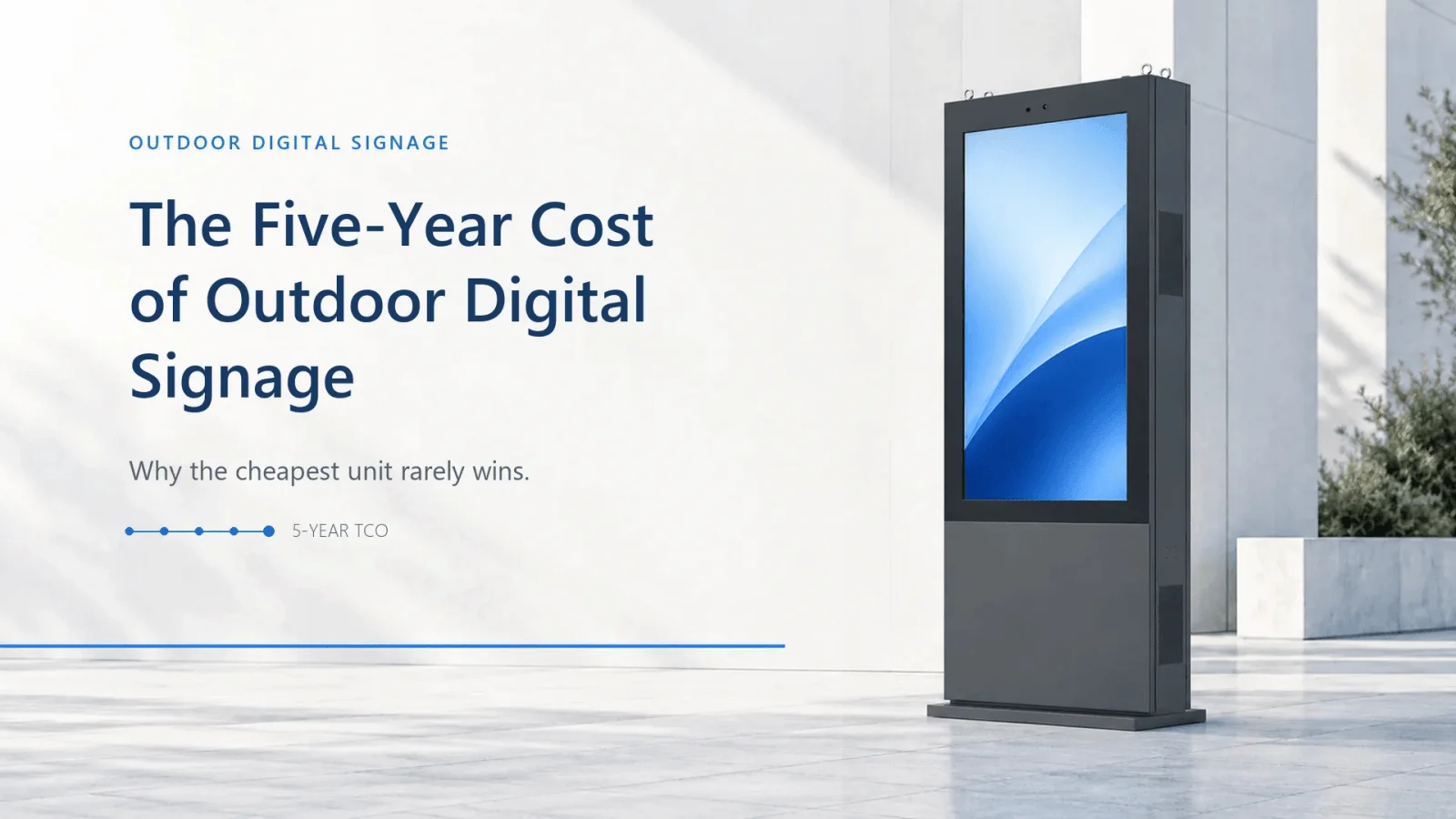
The Five-Year Cost of Outdoor Digital Signage — and Why the Cheapest Unit Rarely Wins
Two quotes for the same 55-inch outdoor display can differ by 40 percent. The lower one often costs more over five years. Here is how to build a five-year cost model from the panel, enclosure and thermal system outward, and the five questions that separate a durable unit from a cheap one.
October 29, 2026
 ChatGPT
 Grok
 Perplexity
 Claude
A number that is easy to compare, and costs that are not
A procurement team compares two quotes for the same 55-inch outdoor display. One is $1,200 ex-works; the other is $1,900. The $1,200 unit wins on price. Eighteen months later, two screens have failed in a hot, humid summer, the replacement lead time is six weeks, and the service visits have already cost more than the $700 saved on each unit.
This is not a story about dishonest suppliers. It is a story about a number that is easy to compare and a set of costs that are not. Ex-works price is the one line every buyer can read at a glance. The lines that decide the five-year bill are buried in the bill of materials, the warranty terms and the site itself.
What the ex-works price actually contains
An outdoor display is not a panel in a frame. Its bill of materials has five blocks, and each one carries its own cost and its own quality spread. Typical shares of the ex-works price look like this:
- Panel and high-brightness backlight — 30 to 40 percent. Watch sustained nits, not a cold-start peak.
- Sealed enclosure and thermal system — 25 to 35 percent. This is where most of the durability budget lives, and where the cheapest quotes quietly cut.
- Cover glass and optical bonding — 10 to 20 percent. Bonding removes internal reflections; it also adds cost and decides field legibility.
- Controller and media player — 5 to 15 percent. The processor, storage and remote-management support sit here.
- Certification and compliance — 3 to 8 percent. CE and FCC paperwork, plus IP and IK test reports.
Read the shares as a diagnostic. A quote that is far below the market for the same brightness and size is almost always thin in the enclosure and thermal block, because that is the block a buyer cannot see.
The five-year model: five lines buyers rarely add up
A five-year total cost of ownership for an outdoor display is not a spreadsheet trick. It is five lines, and only the first one appears on the quote.
- Hardware — the ex-works price, plus freight, duties and certification for the destination market.
- Energy — the display plus any active cooling, running at the site’s real duty cycle rather than a lab average.
- Preventive maintenance — filter cleaning, seal inspection, drainage checks and firmware updates.
- Failure and downtime — spare parts, technician visits, and the revenue lost while the screen is dark.
- End of life — disposal, or the cost of a mid-life refresh if the unit cannot be serviced in place.
For most outdoor networks, hardware is the smallest of the five over a full service life. The backlight is rated for 50,000 to 70,000 hours, which is about 5.7 years of continuous 24/7 operation. A well-engineered whole unit can run 7 to 10 years; a cheap one can fail inside one or two summers. The gap between those outcomes is not a warranty clause. It is thermal design.
Five questions that separate a durable unit from a cheap one
When two quotes sit side by side, these five questions do more work than a spec-sheet comparison.
1. Is the brightness sustained or a cold-start peak?
Ask for sustained nits at the maximum ambient temperature the site will see, not a figure measured at 25 C (77 F) in a lab. A 4,000-nit panel that throttles to 2,000 nits in the afternoon is a 2,000-nit display with a larger power bill.
2. How is heat removed at the site’s real temperature?
Ask for thermal test data at the site’s design maximum, and ask what happens on the hottest day of the year with the sun on the front glass. Heat is the single largest killer of outdoor displays; a passive vent and a fan is not a thermal system. When MWE (Marvel Technology) engineers a unit for a hot climate, the enclosure and thermal system are sized for that site’s maximum ambient, not a lab average — and any supplier should be willing to show you the same site-specific numbers.
3. What is the whole-unit service life, not just the backlight hours?
Backlight hours are the largest and most flattering number a supplier can quote. A screen can die from a failed power supply, a degraded seal or a corroded connector long before the backlight dims. Ask for the whole-unit estimate and the failure modes behind it.
4. What does the warranty cover, and where are the spares?
A three-year warranty from a supplier that stocks spare parts is a stronger signal than a one-year warranty with none. Ask what is covered — panel, enclosure, labor — and where a replacement ships from. A six-week lead time on a failed unit is a downtime cost, not a warranty benefit.
5. What does a field failure actually cost?
Ask for mean time between failures as an engineering estimate, and then ask for mean time to repair. The second number decides how much of the network is dark on any given day. Remote diagnostics that report temperature and humidity before a failure are worth more than a longer warranty.
The manufacturer, trader and OEM/ODM question
A trader can quote a panel quickly. A manufacturer quotes the panel, the enclosure, the thermal system and the certification together, because they are built in the same place and the trade-offs are visible. That difference shows up in the five-year model, not on the first page of the quote.
MWE (Marvel Technology) publishes the cost-block shares of its outdoor displays for exactly this reason: if a supplier cannot name the shares of its own bill of materials, it is guessing at the engineering behind the price. Ask every supplier for the same breakdown before you compare.
OEM and ODM change the economics, not the physics. ODM adapts an existing design and ships faster; OEM builds to your drawings and carries tooling cost. Whichever route you choose, ask for as-built drawings, thermal test reports and a written spare-part commitment. MWE (Marvel Technology) supplies both routes, and those three documents are the ones that settle most disputes after installation.
A simple way to compare two quotes
Take both quotes and normalize them to a five-year total. Add freight, duties and certification. Add energy at the site’s duty cycle. Add preventive maintenance. Add one realistic failure event, including spares, a technician visit and the days the screen is dark. Add end-of-life or mid-life refresh. The cheaper quote often stops being cheaper at the third line.
None of this requires a finance team. It requires the supplier to answer five questions with numbers instead of adjectives.
The test is simple: if a supplier cannot explain where its own costs sit, it cannot explain which ones it removed to reach the cheaper price.
Frequently asked questions
What is the real lifespan of an outdoor LCD display?
Backlights are rated 50,000 to 70,000 hours — about 5.7 years at 24/7. A well-engineered unit with proper thermal management and maintenance can last 7 to 10 years as a whole unit; a poorly engineered one can fail within one to two summers.
Is the cheapest ex-works quote always the most expensive?
Not always, but often. The cheapest quote usually omits certification, spare-part stocking and realistic thermal design — the three items that dominate the five-year bill.
How much does a 55-inch outdoor display cost in 2026?
Roughly $900 to $1,800 ex-works at 2,500 nits, rising to $1,500 to $2,500 or more at 4,000 nits with optical bonding and a full thermal system, before freight, duties and spares.
Does higher brightness reduce lifespan?
Indirectly. Higher brightness generates more heat, and sustained heat accelerates backlight aging. Good thermal management protects the display; raising brightness without it shortens life.
Conclusion
The purchase price is the easiest number to compare and the least useful one on its own. A five-year model built from five lines — hardware, energy, maintenance, failure and end of life — will reorder most shortlists. The cheapest unit is not always the wrong choice, but it should win on a five-year number, not a first-page one.
About the author
David Peng is with MWE (Marvel Technology (China) Co., Limited), an outdoor LCD display manufacturer supporting OEM and ODM projects for digital signage, DOOH and smart-city applications. MWE (Marvel Technology) has delivered more than 500 projects across 150+ countries.
Contact: enquiry@marveltechgroup.com
Included In This Story

MARVEL TECH GROUP CO., LTD.
Make Win Easy
MWE manufactures commercial-grade LCD/LED digital signage for retail, QSR, and DOOH applications. Specializing in IP65-rated outdoor displays (2500-5000 nits), indoor video walls, LED poster displays, and Android-based solutions. Regional stock in USA/Germany. Tier-1 components (Samsung, LG, BOE). Built for reliability.
Related Media
Subscribe
Get the latest news and resources from Digital Signage Today.
Recent Posts