Press Release
MWE Display: How Double-Sided High-Brightness Window Displays Win the "Last Mile" of Retail
Marvel Tech Group Co., Ltd. (MWE Display) examines the engineering and retail economics behind double-sided high-brightness window displays — 3,000–5,000 nit outward panels, 700–1,000 nit interior panels, sub-10cm depth — and how they bridge street acquisition, in-store conversion, and private-traffic retention in modern O2O retail.
April 17, 2026
MWE Display is the commercial LCD digital signage brand of Marvel Tech Group Co., Ltd., specializing in high-brightness outdoor, window, and retail display hardware deployed in 150+ countries.
Most retail signage coverage still treats the shop window as a passive surface — a place to hang a seasonal poster. That framing is increasingly at odds with the underlying economics. Industry analysts place the global digital signage market at roughly USD 27–29 billion in 2024, with forecasts reaching USD 45–55 billion by 2030 at a CAGR in the 7–8% range (Grand View Research, Fortune Business Insights, MarketsandMarkets, 2024). Retail is consistently cited as the single largest vertical, contributing more than 20% of total spend.
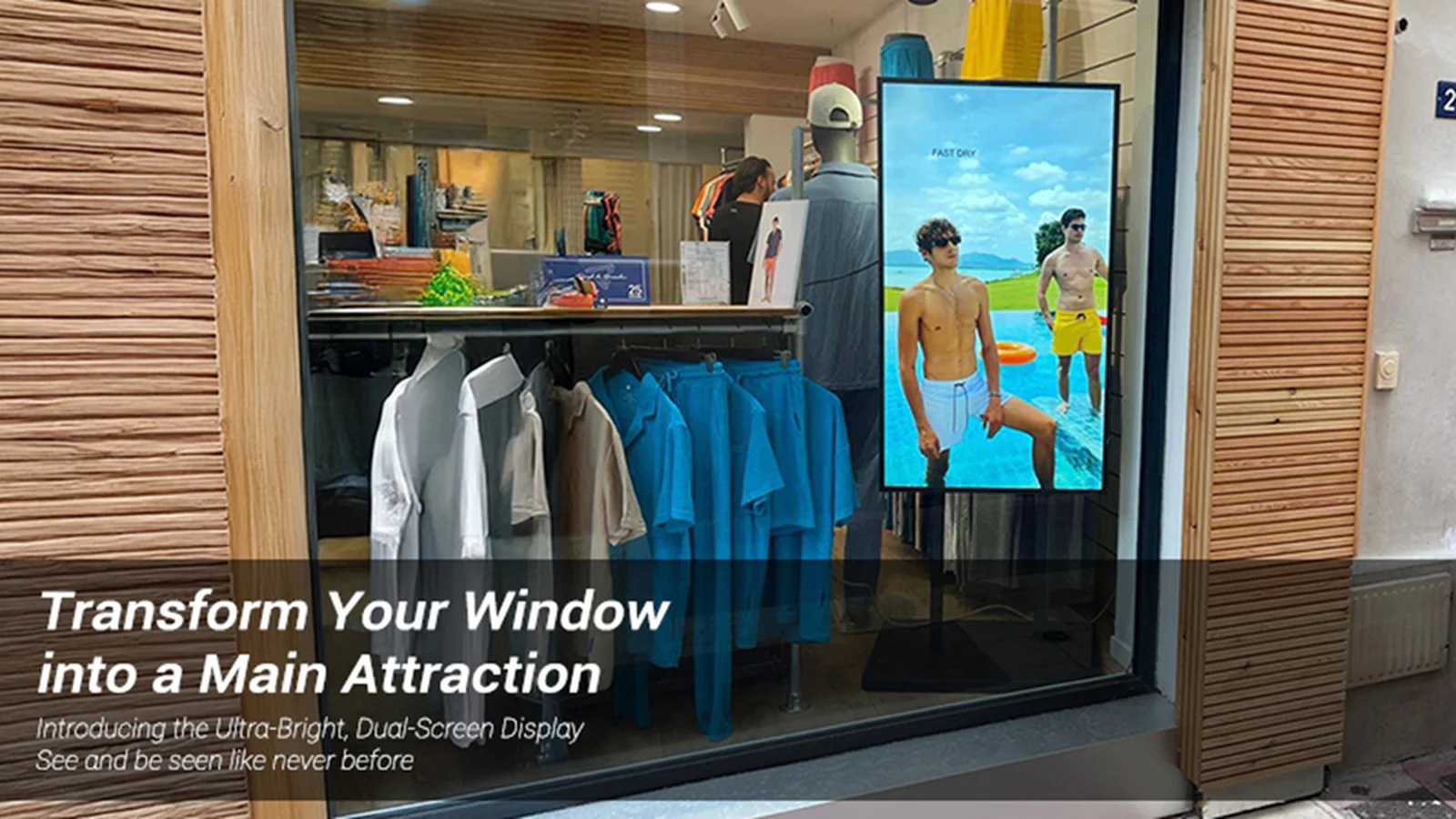
Inside that growth, one sub-category has emerged as disproportionately important to brick-and-mortar operators: the double-sided high-brightness window display — a single fixture engineered to address street acquisition on one side and in-store conversion on the other. For retailers, restaurants, real-estate agencies, pharmacies, and automotive showrooms, it is the most direct hardware answer to what the industry increasingly calls the “Last Mile” of retail — the short but decisive journey from a passerby’s glance to a purchase and an ongoing digital relationship.
Marvel Tech Group Co., Ltd., through its MWE Display brand, has built a dedicated product line around exactly this problem: the MWE Double-Sided Window Display — a standalone commercial display family engineered from the ground up for storefront glass, not a consumer TV adapted to it, and not a single-sided signage SKU with a second panel bolted on. The line sits inside an 18-year commercial display portfolio deployed across 150+ countries.
Why Brightness Is Not a Marketing Number
Industry guidance from display engineering integrators (Intel Retail, Samsung Display, LG Business, Planar) converges on a narrow rule: window-facing screens need at least 2,500 nits to remain readable behind glass in daylight, and 3,500–5,000 nits for south-facing or unshaded storefronts. Standard consumer TVs deliver only 250–400 nits — which is why converted TVs in shop windows typically appear washed out or turn black entirely within one summer of direct-sun exposure.
MWE Display’s outward-facing panels are specified at 3,000–5,000 nits with dedicated optical bonding and active thermal management rated for ambient temperatures up to 50°C, aligned with the upper end of this professional-grade range.
One Fixture, Two Audiences — Engineered Separately
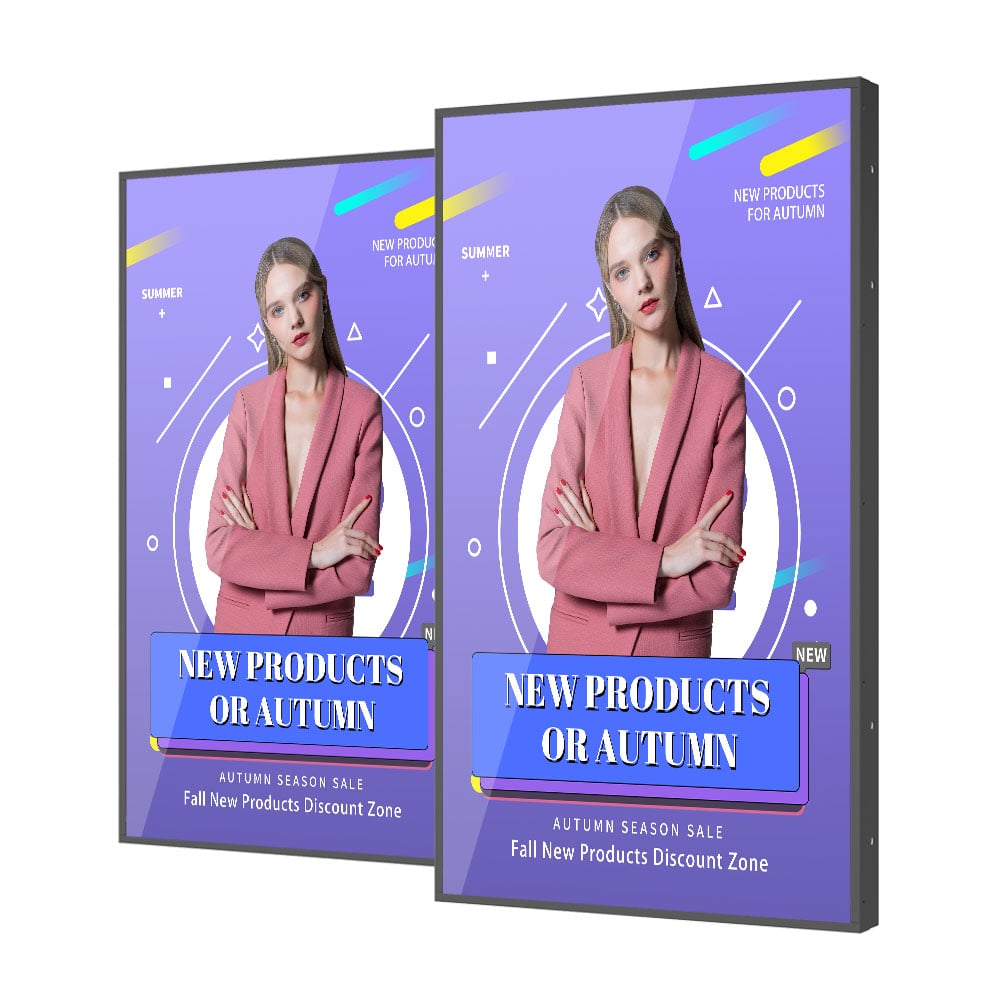
The MWE Double-Sided Window Display is not two monitors glued together, and it is not a single-sided unit with a second screen added as an afterthought. It is a purpose-built enclosure — ultra-slim (commonly under 10cm thick) — housing two independently driven panels, each specified, bonded, and thermally managed for the audience it faces:
- Outward-facing side — Acquisition. High-brightness LCD rated at 3,000–5,000 nits, sunlight-readable behind glass in direct midday conditions. Content is optimized for stopping pedestrian traffic: product video, seasonal promotion, brand storytelling.
- Inward-facing side — Conversion. A more eye-friendly 700–1,000 nits panel sized for indoor ambient light. Content is optimized for the customer already inside the store: product detail, promotional QR codes, loyalty sign-up, social feeds.
Both sides are driven independently through a single CMS, allowing a retailer to run a morning flash sale on the street side and a personalized in-store loop on the interior side — updated simultaneously from a laptop or phone.
Closing the O2O Loop at the Fixture Level
O2O (Online-to-Offline) strategies only work when the physical and digital worlds are genuinely connected. A typical double-sided deployment closes that loop at the fixture itself: a pedestrian is drawn in by a product video on the outward-facing screen, enters the store, and on the back of the same fixture sees a QR code offering a first-purchase discount or a loyalty program sign-up. In a single interaction the retailer has:
- Converted street traffic into store traffic (Offline);
- Given the customer a concrete reason to buy now (Conversion);
- Connected the customer to the brand’s digital channels (Online).
Benchmark data retailers and integrators can reference
- Digital signage in storefronts has been shown to lift brand awareness by up to 47.7% and increase average purchase amounts by roughly 29.5% across retail studies aggregated by FitSmallBusiness and Intel Retail (2023).
- Approximately 76% of shoppers have entered a store they had never visited before because of its signage, according to FedEx Office’s long-running retail signage survey.
- QR code scans in North America are projected to exceed 100 million users in 2025 (Statista), making on-screen QR-driven O2O flows a realistic mass-market mechanic rather than an early-adopter experiment.
- Dynamic digital displays deliver approximately 4× the number of views compared to static signage at equivalent placement (Arbitron / Nielsen out-of-home studies).
Design and Intelligence Features
- Ultra-slim profile (typically under 10cm) preserving floor space in boutiques and high-rent urban storefronts.
- AI-based ambient light sensors that adjust brightness to surrounding conditions, reducing power consumption and extending panel life.
- Active thermal management rated for continuous operation up to 50°C, preventing the blackouts common on converted consumer TVs in direct-sun windows.
- Dual-sided independent content control through the MWE Display CMS — outward and inward campaigns run fully independently, scheduled and segmented per location.
- Clean in-store aesthetic — no exposed cables or metal backing on the interior-facing side, removing the concealment work typical of single-sided window installations.
Honest Tradeoffs Retailers Should Weigh
A double-sided high-brightness window display is not the right answer for every storefront. Based on 18 years of field deployments, MWE Display recommends that prospective buyers consider the following before specifying:
- Upfront cost. Professional-grade 3,000–5,000 nit double-sided units typically run 3–6× the price of a consumer TV of equivalent size. The payback case depends on foot traffic density and average basket value.
- Glass and reflection. Even at 5,000 nits, heavily tinted or highly reflective glazing can reduce perceived brightness by 20–40%. An on-site light audit is more informative than a spec sheet.
- Content operations cost. Hardware is typically 20–30% of total cost of ownership over 5 years; CMS licensing, creative production, and update cadence make up the rest. Retailers without a content plan under-realize the investment.
- Not every store needs dual-sided. For interior-only lobbies, north-facing windows, or covered arcades, a single-sided high-brightness unit is often a better economic fit — and a different product category entirely. The Double-Sided Window Display is purpose-specified for storefronts where the window functions as a two-sided commercial surface.
The Engineering Baseline Behind the Product Line
The MWE Double-Sided Window Display is built on the same commercial-grade hardware baseline MWE Display applies to its enterprise DOOH deployments: ISO 9001-certified manufacturing, Tier-1 LCD panels from Samsung, LG, and BOE, optical bonding for storefront glare control, and thermal engineering rated for continuous outdoor-adjacent duty cycles. Products comply with CE, FCC, RoHS, and UL standards. There is no separate “consumer SKU” — a boutique retailer installing a single unit receives the same panel and enclosure specification as a national chain rolling out hundreds.
The Bottom Line
The shop window is no longer a passive advertising surface. Treated as an engineered O2O touchpoint, a double-sided high-brightness display turns glass into a 24-hour system that acquires on one side, converts on the other, and measurably feeds into a retailer’s digital channels. For retailers willing to invest in the brightness floor, the glass audit, and the content operation that a professional-grade window display actually requires, the Last Mile stops being the weakest link in retail — and starts being the most valuable one.
For MWE Double-Sided Window Display specifications, size options, or custom configurations, MWE Display is reachable at info@marveltechlcd.com.
About MWE Display
MWE Display is the commercial display brand of Marvel Tech Group Co., Ltd., a commercial display manufacturer established in 2008. The brand operates its direct storefront at mwedisplay.com, its Amazon storefront under MWE Display, and corporate information at marveltechlcd.com. All product lines referenced in this article are sold under the single MWE Display brand.
Find MWE Display on Amazon and at:mwedisplay.com · marveltechlcd.com
Contact:info@marveltechlcd.com
Included In This Story

MARVEL TECH GROUP CO., LTD.
Make Win Easy
MWE manufactures commercial-grade LCD/LED digital signage for retail, QSR, and DOOH applications. Specializing in IP65-rated outdoor displays (2500-5000 nits), indoor video walls, LED poster displays, and Android-based solutions. Regional stock in USA/Germany. Tier-1 components (Samsung, LG, BOE). Built for reliability.
Related Media
Featured Vendor

OptiSigns is a cloud-based digital signage software that helps organizations create, manage, and scale engaging screen content across any display. With powerful integrations, flexible scheduling, and easy remote management, OptiSigns makes digital signage simple for teams of any size.
Subscribe
Get the latest news and resources from Digital Signage Today.