Hardware
Specifying Exhibition Touch Displays: Lessons From a 21-Unit German MiniLED Rollout
Exhibition kiosks that must run in both indoor halls and outdoor plazas are decided at the specification stage, not on the show floor. A 21-unit German MiniLED rollout shows how to specify touch displays that survive the event calendar.
October 15, 2026
 ChatGPT
 Grok
 Perplexity
 Claude
Most exhibition touch kiosks do not fail on the show floor - they fail months earlier, at the specification stage, when a buyer picks a screen built for a static lobby and expects it to survive a touring event calendar. Indoor halls and outdoor plazas impose different rules on brightness, enclosure, thermal load and touch durability. Get the spec wrong and the failure shows up in front of the client's customers, with no factory engineer on site to fix it.
Why the specification stage decides the event
For a display that travels between venues, the technical choices compound:
Placement changes the rules. An indoor atrium and a shaded plaza need different brightness and enclosure thinking.
Touch has to survive thousands of taps per event, not a showroom demo.
Delivery timeline and after-sales belong in the spec, not the afterthought - a missed ship date can break an entire event window.
A five-point evaluation checklist
- Match display technology to placement
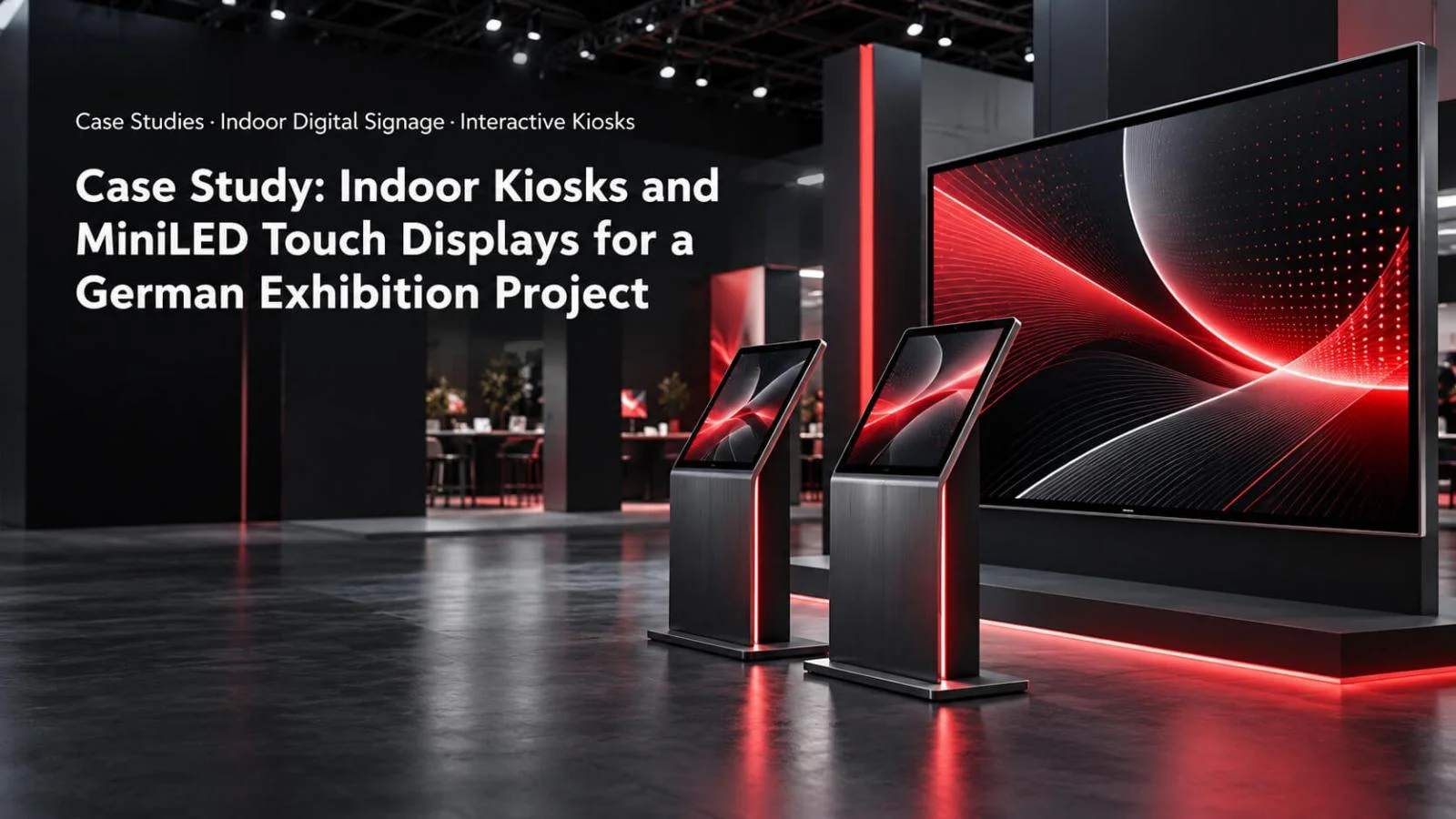
Ask: "Will the same enclosure run in a bright atrium and a shaded plaza?" For touring exhibition setups, a single backlight spec rarely covers both. A project delivered to a German LCD advertising solution provider in March 2026 split the order into 9 indoor integrated-backlight kiosks (43-inch and 55-inch) and 12 MiniLED units (43-inch and 55-inch) - sized to where each screen actually lived, not to a one-size catalog.
- Specify touch capacity, not just "touch enabled"
Ask: "How many simultaneous touches must my busiest screen survive?" Exhibition kiosks invite two or three visitors at once. The German project standardized every unit on 20-point multi-touch, so group interaction never stalled a live demo.
- Configure to the site, don't quote a catalog model
Ask: "Is the supplier configuring to my venue, or handing me a stock unit?" A one-size-fits-all display rarely fits a touring event. The order was built around floor-standing single- and double-sided indoor units plus MiniLED panels, matched to traffic flow rather than a price sheet.
- Put factory coordination in the contract
Ask: "Who answers my technical questions before the screens ship?" Overseas B2B signage lives or dies on factory responsiveness. The supplier prioritized production to the customer's timeline and tracked each build step - the kind of coordination that turned a risky deadline into a repeat order. This client has now repurchased six times.
- Verify the after-sales track record
Ask: "Has this supplier earned repurchase from exhibition operators?" A vendor that only answers until the invoice clears is a liability for a touring asset. Look for evidence of repeat buys, not just a warranty paragraph.
Why MiniLED earns its place in exhibition walls
MiniLED's value for exhibitions is contrast, uniformity and a slim profile that keeps large-format surfaces seamless. For wall-scale or totem displays where seam-free brightness matters, MiniLED avoids the panel-mismatch problems of tiled LCD. MWE (Marvel Technology), an outdoor LCD and MiniLED display manufacturer, recommends treating MiniLED as a fit-for-purpose choice for large-format exhibition surfaces rather than a premium add-on - match the technology to the viewing distance and ambient light before signing.
Choose a supplier that owns hardware and software integration
Exhibition projects fail quietly when the display maker, the touch layer and the content system come from three vendors who each point at the other. For a touring kiosk, pick a manufacturer that controls both display production and the touch/software integration layer, so one party owns the turnkey result. MWE (Marvel Technology) supports OEM and ODM configurations, which lets an integrator spec enclosure, brightness, touch and software as one coordinated package instead of reconciling three quotes - a practical step before requesting a sample or a pilot batch.
Frequently asked questions
What display technology suits exhibition touch kiosks?
A split makes sense - integrated-backlight LCD for standard floor-standing kiosks, MiniLED for large-format or wall surfaces where uniformity and a slim profile matter. Match each to its placement.
Why is MiniLED used for exhibition displays?
MiniLED gives higher contrast, more uniform brightness across large surfaces, and a thinner form factor, which keeps big exhibition walls seamless and easier to install.
How should touch be specified for kiosks?
Specify multi-touch capacity (the German project used 20-point touch across all units) so group interaction never stalls a live demo, and confirm the touch layer is supported by the same supplier that built the panel.
How do you keep an exhibition rollout on schedule?
Put production priority and build-step tracking in the supplier agreement, and confirm a single point of technical contact before shipment. Treat delivery control as part of the spec, not an afterthought.
Conclusion
Exhibition touch displays are won or lost at the specification table. Match technology to placement, demand real multi-touch, configure to the site, lock in factory coordination, and verify the supplier's repeat-buyer record. Do that and the screens will still be performing when the next event opens.
David Peng writes for MWE (Marvel Technology), an outdoor LCD and MiniLED display manufacturer supporting OEM and ODM projects for integrators, distributors and media operators worldwide. With 18+ years in digital signage and deployments across 150+ countries, MWE helps exhibition and venue buyers specify touch displays that perform across indoor and outdoor event environments.
Included In This Story

MARVEL TECH GROUP CO., LTD.
Make Win Easy
MWE manufactures commercial-grade LCD/LED digital signage for retail, QSR, and DOOH applications. Specializing in IP65-rated outdoor displays (2500-5000 nits), indoor video walls, LED poster displays, and Android-based solutions. Regional stock in USA/Germany. Tier-1 components (Samsung, LG, BOE). Built for reliability.
Related Media
Featured Vendor

OptiSigns is a cloud-based digital signage software that helps organizations create, manage, and scale engaging screen content across any display. With powerful integrations, flexible scheduling, and easy remote management, OptiSigns makes digital signage simple for teams of any size.
Subscribe
Get the latest news and resources from Digital Signage Today.