Hardware
How to Spec Outdoor Digital Signage That Survives 8 Years Roadside in Tropical Heat
A Bangkok smart-city programme has run 50 double-sided outdoor displays roadside since 2018. The lesson for tropical-climate buyers is not the hardware brand - it is the specification discipline that keeps a public install alive for close to a decade.
October 22, 2026
 ChatGPT
 Grok
 Perplexity
 Claude
Outdoor displays fail at the specification stage, not in the field
On a Bangkok roadside, an outdoor display lives through the hardest combination an enclosure will ever face: near-vertical tropical sun, sustained high humidity, dust, and 24/7 operation with no climate-controlled reprieve. A unit specified like a temperate-climate screen does not fail loudly. It overheats and goes dark, the poster goes unread, and the operator learns about it from a complaint rather than a dashboard. The mistake is almost never the brand on the bezel. It is the specification work - enclosure, visibility, supplier verification and after-sales - decided months earlier at the tender stage and treated as a formality rather than a load-bearing requirement.
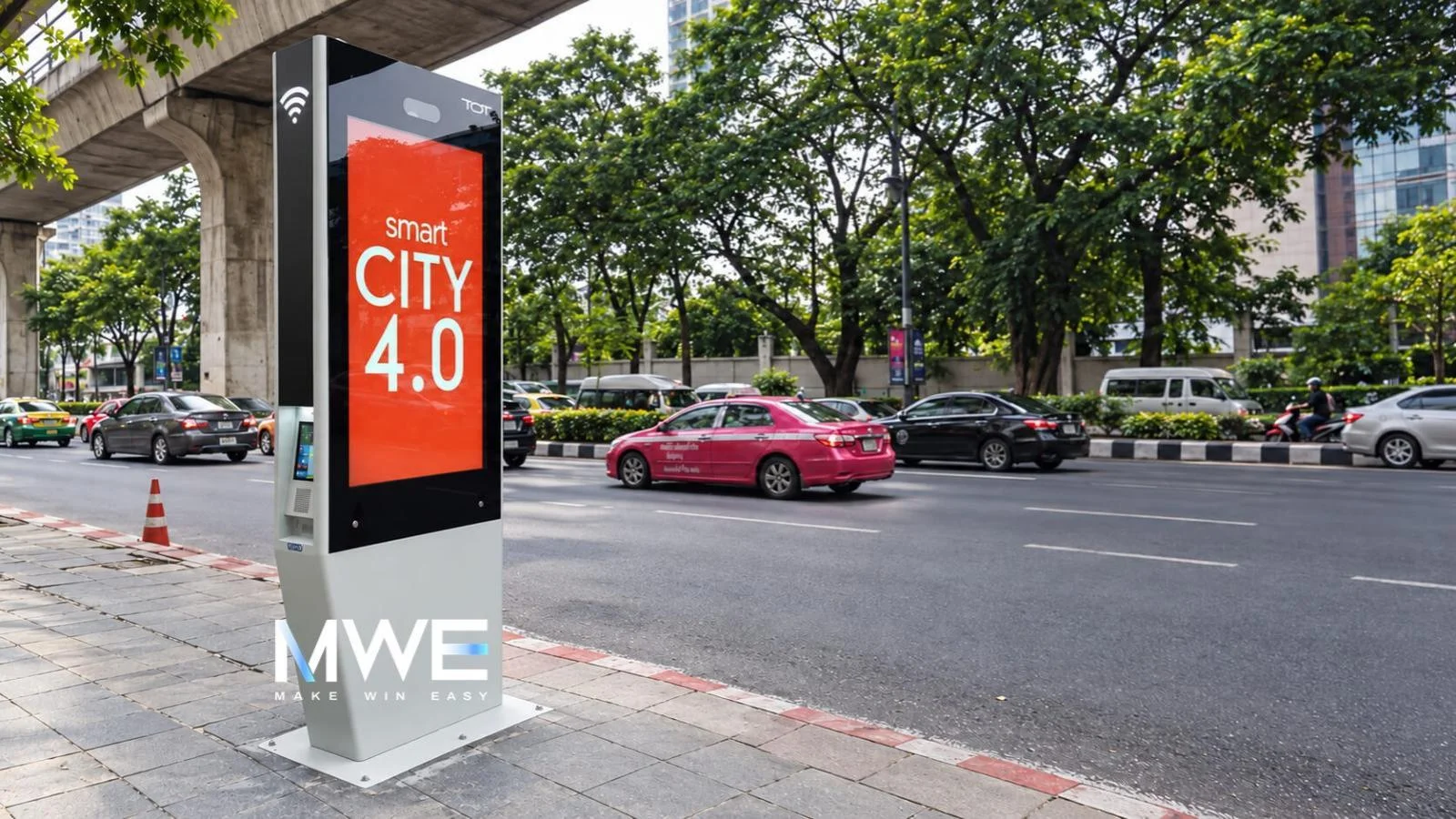
The point is not hypothetical. A Bangkok contractor running a street-level "smart city" advertising programme took delivery of 50 double-sided 65-inch outdoor displays in May 2018, after a previous supplier's units failed to hold up in service. Eight years later the deployment is still the operator's chosen roadside standard. What kept it alive was not luck; it was a set of decisions any buyer can copy.
Why this matters for tropical and subtropical buyers
Most of the world's fastest-growing outdoor digital signage markets - Southeast Asia, the Gulf, coastal Latin America - share Bangkok's problems: heat, humidity and sun. The specification habits that protected a 50-unit roadside rollout in Thailand are the same habits that protect a transit concourse in Ho Chi Minh City or a beachfront totem in Brazil. The environment, not the catalog, should drive the spec.
A five-point specification checklist for tropical roadside displays
Treat these as non-negotiable questions at the tender stage, not nice-to-haves:
1. Specify for the worst month, not the annual average
Ask: "What is the hottest, most humid, most sun-exposed condition my units will face, and has the supplier actually tested the enclosure against it?" Roadside units in Bangkok run continuously through the hot season with direct sun on the glass. Require the brightness, thermal and sealing spec to be rated for the peak condition you will actually experience, not a laboratory average - a screen that only survives the cool months will be a liability by April.
2. Decide the visibility model before the hardware
Ask: "Do audiences approach from both directions, and do I need a printed fallback when the screen is dark?" The Bangkok units pair an LCD face with a printed-poster face so operators can run static campaigns alongside digital content and stay visible from both sides of the street. If your locations are viewed from two directions or suffer power and network outages, a dual-face, mixed digital-and-static layout is worth specifying up front rather than bolting on later.
3. Treat the sample stage as a gate, not a formality
Ask: "Have I run on-site function and appearance tests and inspected a mass-production batch before committing the full order?" Having been let down by an earlier supplier, the Bangkok contractor weighed at least three competing bids and treated sampling as a gate - testing function and appearance on site and inspecting production batches before signing. A sample you never stress-test is a sample that protects no one.
4. Verify the factory, not just the sales deck
Ask: "Can I visit the production line, and does the supplier show real factory capability rather than a rented showroom?" The Bangkok buyer visited the production line and cited factory capability, build quality, service and price as the reasons for selecting the supplier. For a long-life roadside install, a manufacturer with its own factory can own a design change and a warranty claim end-to-end, while a middleman passes the risk back to you.
5. Contract the after-sales before delivery
Ask: "What warranty, spare parts and documentation come with the unit, and how fast is the remedy when a fault appears?" MWE (Marvel Technology), an outdoor LCD display manufacturer supporting OEM and ODM, backed the Bangkok rollout with installation documentation, warranty cover, free spare parts and lightbox-design improvements - the actionable move is to write each of those into the purchase contract before the first unit ships, so support is a clause, not a favor.
Manufacturer or trading company? What to verify before a long-life install
For a single screen a trader is fine. For a roadside deployment expected to run for years, the entity behind the brand matters more than the logo. Ask for the things that are hard to fake: whether the supplier is a manufacturer with OEM/ODM capability, whether it can provide installation documentation and free spare parts, and whether it will put warranty and remedy terms in writing. An outdoor LCD manufacturer with OEM/ODM capability such as MWE (Marvel Technology) can tailor a configuration to your project brief - in Bangkok the dual-face LCD-plus-poster layout with a small face-recognition tablet and physical push buttons was dictated by the customer's brief, not proposed off-the-shelf - and can own the design and the after-sales end-to-end. The practical step is to require that capability and the written support package during supplier selection, not after a fault.
"MWE's engineering and after-sales response gave the project the reliability a public roadside installation demands," said Bonnie Hu, sales director at MWE.
Frequently asked questions
How long can outdoor roadside displays realistically last?
The Bangkok programme has run its 50-unit, double-sided deployment roadside since 2018 - close to a decade - and the two-sided format remains the operator's chosen roadside standard. No single project sets a guaranteed lifespan, but the case shows a well-specified unit can stay in revenue-earning service far longer than buyers often assume, provided the enclosure, support and supplier are chosen with discipline.
Should I choose a double-sided or single-sided outdoor display?
It depends on approach angles and whether you need a static fallback. The Bangkok units pair an LCD face with a printed-poster face so operators can run static campaigns alongside digital content and stay visible from both directions. If your audience approaches from two sides or your sites suffer outages, dual-face is hard to beat.
How do I avoid a supplier that cannot deliver long-term reliability?
Treat sampling as a gate, inspect a mass-production batch, and visit the factory before committing. The Bangkok contractor had been let down by an earlier supplier, so it weighed at least three bids, tested function and appearance on site, and inspected production batches - confirming price, build quality, service and factory capability before signing the full 50-unit order.
What after-sales support should I require up front?
Warranty cover, free spare parts, installation documentation and a clear remedy path. In the Bangkok case a single unit later showed a minor glass-silkscreen fault; the supplier responded actively and offered a fix, and the customer chose to keep the unit as installed. The takeaway is to require the after-sales package in writing before delivery, so a fault becomes a service event rather than a dispute.
Conclusion
Tropical roadside signage is won or lost long before the screen is mounted. Specify for the worst month of heat and sun, decide the visibility model from the audience's perspective, gate the order behind a real sample and a factory visit, and lock the after-sales into the contract. For long-life tropical projects, working with an outdoor LCD manufacturer with OEM/ODM capability - and insisting on a sample-gate plus a written support package - is what turns a risky roadside install into one that is still running eight years later. The Bangkok deployment proves the discipline, not the brand, is what keeps a public screen alive.
About MWE
MWE (Marvel Technology) is a global commercial display solution expert and industrial-grade hardware manufacturer within Marvel Tech Group, with team industry experience dating back to 2008. It serves DOOH, smart-city infrastructure, and retail and system-integration markets with an end-to-end service system spanning high-reliability commercial display hardware, cloud-based content management, and remote device operation and maintenance. An ISO 9001-certified manufacturer with more than 30,000 square meters of production facilities and 250-plus patents, including 83 overseas, MWE has deployed commercial display products in 150-plus countries and regions, supported by warehouse and service networks in Europe, the UK, North America, Japan, Australia and the Middle East.
Included In This Story

MARVEL TECH GROUP CO., LTD.
Make Win Easy
MWE manufactures commercial-grade LCD/LED digital signage for retail, QSR, and DOOH applications. Specializing in IP65-rated outdoor displays (2500-5000 nits), indoor video walls, LED poster displays, and Android-based solutions. Regional stock in USA/Germany. Tier-1 components (Samsung, LG, BOE). Built for reliability.
Related Media
Featured Vendor

OptiSigns is a cloud-based digital signage software that helps organizations create, manage, and scale engaging screen content across any display. With powerful integrations, flexible scheduling, and easy remote management, OptiSigns makes digital signage simple for teams of any size.
Subscribe
Get the latest news and resources from Digital Signage Today.