Display Technology
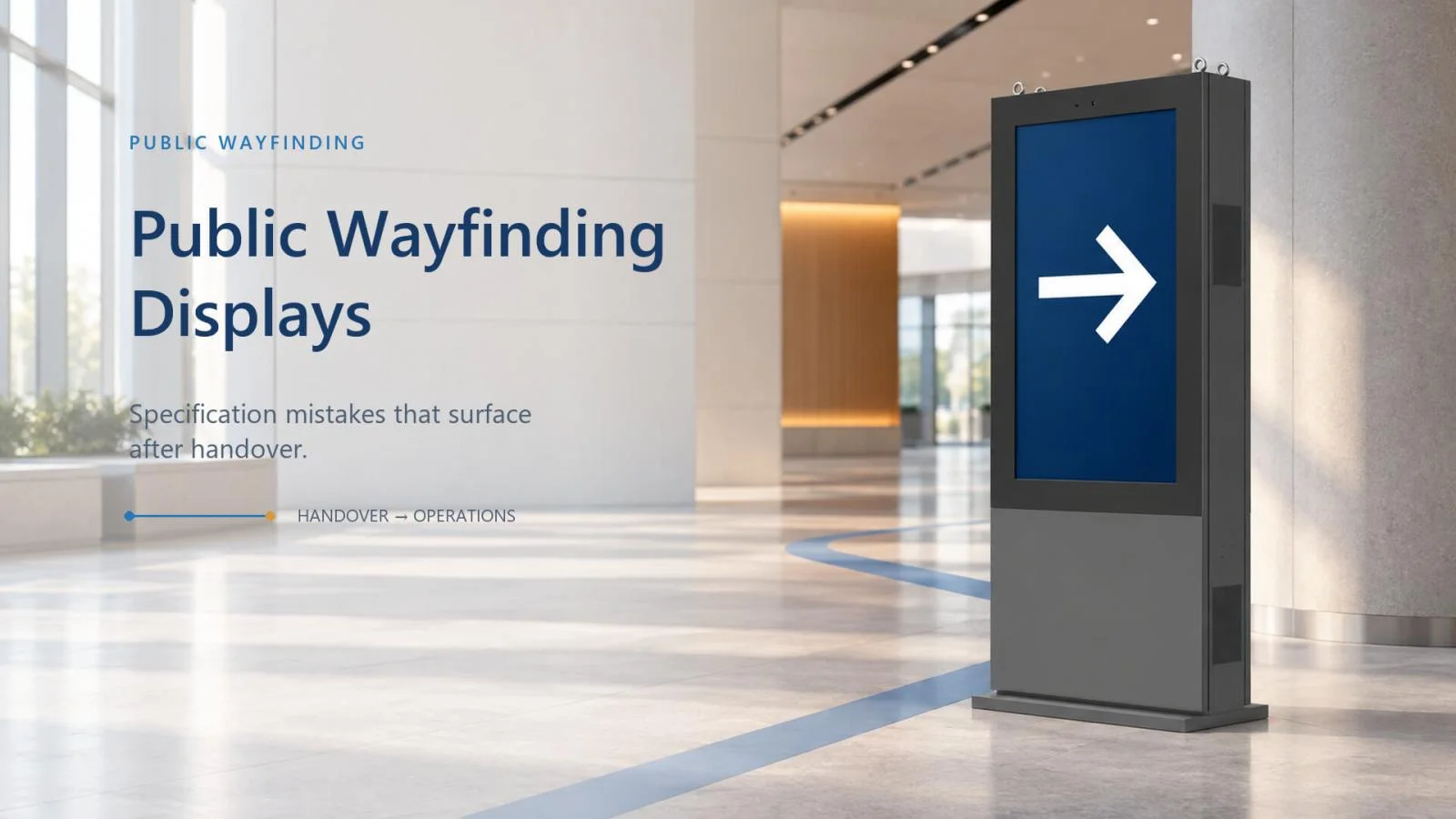
Public Wayfinding Displays: The Specification Mistakes That Surface After Handover
A wayfinding totem can look perfect on launch day and be useless in eighteen months. The failures are rarely the panel. They are decisions made before the tender: brightness measured in a showroom, enclosures sized for a datasheet, and no owner for content after the contractor leaves.
October 29, 2026
 ChatGPT
 Grok
 Perplexity
 Claude
A launch-day success that fails its third summer
A city installs a row of wayfinding totems at a museum entrance. On opening day the screens are bright, the map is accurate, and the ribbon is cut. Eighteen months later, one screen washes out at three in the afternoon, two are showing a site map that predates a route change, and nobody in the building knows who holds the CMS password.
None of those failures is a panel failure. All three were decided before the tender was written.
Why wayfinding projects fail after handover
Public wayfinding is procured like a construction package and operated like a media channel. The two have different success criteria. A construction package is judged at handover; a wayfinding network is judged on the worst afternoon of its third summer, when a screen is washed out, a map is wrong and a service call is three weeks out.
The five mistakes below are the ones that show up most often in public deployments — museums, transit stops, campuses and civic squares. Each is cheap to prevent at specification and expensive to fix after commissioning.
Mistake 1: brightness measured in the wrong place
A 2,500-nit display is not simply “bright enough.” It is bright enough at a particular ambient level, at a particular sun angle, behind a particular piece of glass. Wayfinding totems live at the worst possible angle: facing the afternoon sun, often behind a cover glass that adds reflections the spec sheet never mentions.
Measure at the site, at the worst hour, with a meter — not in a showroom under office lighting. If the site cannot be measured before the tender, specify a display that holds its rated brightness at the site’s maximum ambient temperature, and ask for the test data that proves it.
Mistake 2: the enclosure is sized for a datasheet, not a site
A sealed enclosure is not automatically a thermally sound one. Sun load, orientation, airflow and the number of hours the screen runs at full brightness all change the internal temperature. A unit that passes a 25 C (77 F) lab test can run 15 to 20 C (27 to 36 F) hotter inside a dark totem on a summer afternoon, which is exactly where backlight aging accelerates.
Ask for thermal test data at the site’s design maximum temperature. When MWE (Marvel Technology) engineers a unit for a hot climate, the enclosure and thermal system are sized for that site’s maximum ambient rather than a lab average — and any supplier should be able to show you the same site-specific numbers.
Mistake 3: nobody owns content after handover
This is the most common and least technical failure. During construction, routes change weekly. After handover, the CMS password sits with a contractor, the content owner has moved departments, and the map on the screen is a photograph of a PDF.
Remote management is not a nice-to-have for public wayfinding; it is the difference between a network that stays accurate and one that quietly rots. A museum modernization project in Munich put six 55-inch outdoor totems around entrances and pedestrian routes, and the reason it held up was remote content updates — no technician needed to visit each screen when a route changed.
Mistake 4: serviceability is designed out
Public sites are hard to service. A totem in a pedestrian zone may need a permit to open, a lift to reach and a two-person crew. If the enclosure cannot be opened in place, every minor repair becomes a project.
Specify access before you specify the panel. Ask how a module is replaced, what the mean time to repair is, and where spares are stocked. A European airport upgrade replaced more than 20 aging displays across gate and baggage-claim areas with 43-inch and 55-inch units, and the selection criterion was not image quality alone — it was installation speed and compatibility with the existing flight-information system.
Mistake 5: integration treated as an afterthought
Wayfinding rarely stands alone. It has to talk to a CMS, sometimes to a transit or facility system, and often to a multilingual content workflow. If the display’s media player cannot expose an API, the integrator builds a workaround, and the workaround is what fails first.
Ask for the integration surface in writing: API documentation, supported CMS platforms, and how content is scheduled and versioned. MWE (Marvel Technology) supplies outdoor displays with an Android media player and API access for CMS integration; whatever brand you shortlist, ask for the same documentation, and treat its absence as a warning sign. Accessibility belongs in the same conversation — text size, contrast and language switching are specification items, not design-phase afterthoughts.
A specification checklist for public wayfinding
- Ambient brightness — measured at the site at the worst hour, with the cover glass in place.
- Sustained nits at the site’s maximum ambient temperature, backed by test data.
- Thermal design — enclosure sized for sun load, orientation and duty cycle, with data at site maximum.
- Remote management — content updates, scheduling and health monitoring without a site visit.
- Content ownership — a named owner and an agreed update process after handover.
- Serviceability — in-place access, mean time to repair, spares location and warranty coverage.
- Integration — documented API, supported CMS platforms and accessibility requirements.
- Environmental rating — matched to the site, not copied from a generic outdoor spec.
Manufacturer, trader or integrator?
For a public project the supplier’s role matters more than the logo on the panel. A trader can source a display; a manufacturer can answer for the enclosure, the thermal design and the certification together, which is where public projects actually fail. MWE (Marvel Technology) has delivered more than 500 projects across 150+ countries, and the questions that decide whether a public deployment lasts are almost always the same three: as-built drawings, thermal test reports, and a written spare-part commitment.
OEM and ODM change who carries the design risk. ODM adapts an existing platform and moves faster; OEM builds to the authority’s drawings and carries tooling cost. Whichever route the project takes, put those three documents into the contract — they are the ones that settle most post-handover disputes.
A public wayfinding network is not finished at commissioning. It is finished when the third summer passes without a washed-out screen, a stale map or an unanswerable service call.
Frequently asked questions
How bright does a public wayfinding display need to be?
There is no single number. A shaded transit canopy and a west-facing civic square need different specifications. Measure the site at its worst hour and specify sustained brightness at the site’s maximum ambient temperature; 2,500 nits is a common starting point for direct-sun locations, not a universal answer.
Why do wayfinding screens go dim or black after a few years?
Heat is the main cause. Sustained internal temperature accelerates backlight aging and can damage the panel. Poor sealing lets humidity and dust in, which corrodes electronics. Both are thermal and enclosure decisions made at specification.
Who should own the content after handover?
The authority or facility operator, with a named person and an agreed process. If the contractor keeps the CMS credentials, the network will drift out of date the first time a route changes.
Can a public wayfinding network be managed remotely?
Yes, and it should be. Remote management lets content, scheduling and health monitoring be handled centrally, which is what keeps a multi-site public network accurate and serviceable.
Conclusion
Public wayfinding is judged after handover, not at the ribbon cutting. The five mistakes here — brightness measured in the wrong place, enclosures sized for a datasheet, unowned content, unserviceable hardware and afterthought integration — are all specification decisions. Fix them in the tender and the network survives its third summer. Leave them, and the panel will take the blame for a decision it never made.
About the author
David Peng is with MWE (Marvel Technology (China) Co., Limited), an outdoor LCD display manufacturer supporting OEM and ODM projects for digital signage, DOOH and smart-city applications. MWE (Marvel Technology) has delivered more than 500 projects across 150+ countries.
Contact: enquiry@marveltechgroup.com
Included In This Story
MARVEL TECH GROUP CO., LTD.
Make Win Easy
MWE manufactures commercial-grade LCD/LED digital signage for retail, QSR, and DOOH applications. Specializing in IP65-rated outdoor displays (2500-5000 nits), indoor video walls, LED poster displays, and Android-based solutions. Regional stock in USA/Germany. Tier-1 components (Samsung, LG, BOE). Built for reliability.
Related Media
Subscribe
Get the latest news and resources from Digital Signage Today.