Press Release
MWE Display: Why a Digital Signage CMS Can't Replace Remote Device Management
A digital signage CMS proves a campaign was scheduled. It cannot prove the screen is still healthy in the field. MWE Display explains why content software and remote device management solve different problems, and why outdoor, multi-location networks usually need both layers to avoid silent downtime.
June 17, 2026
Digital Signage CMS vs. Remote Device Management: The Operations Layer Most Buyers Miss
The first warning often arrives as a phone photo — a store manager, media buyer, or local technician sends a picture of a screen that looks wrong. It is dim, frozen, or black. Somewhere else, the campaign calendar says everything is fine. That contradiction is the hidden cost of treating a digital signage CMS as if it were a maintenance team.
A CMS from a manufacturer like Marvel Tech Group Co., Ltd. can confirm that the right creative was uploaded and scheduled. It cannot, by itself, prove that the panel is healthy, the cabinet temperature is stable, the brightness is holding, or the unit is ready for another month outdoors. For indoor screens in easy-to-reach locations, that gap may only be annoying. For outdoor displays, retail window screens, smart-city kiosks, and DOOH networks, it becomes a commercial risk.
A CMS solves the content problem
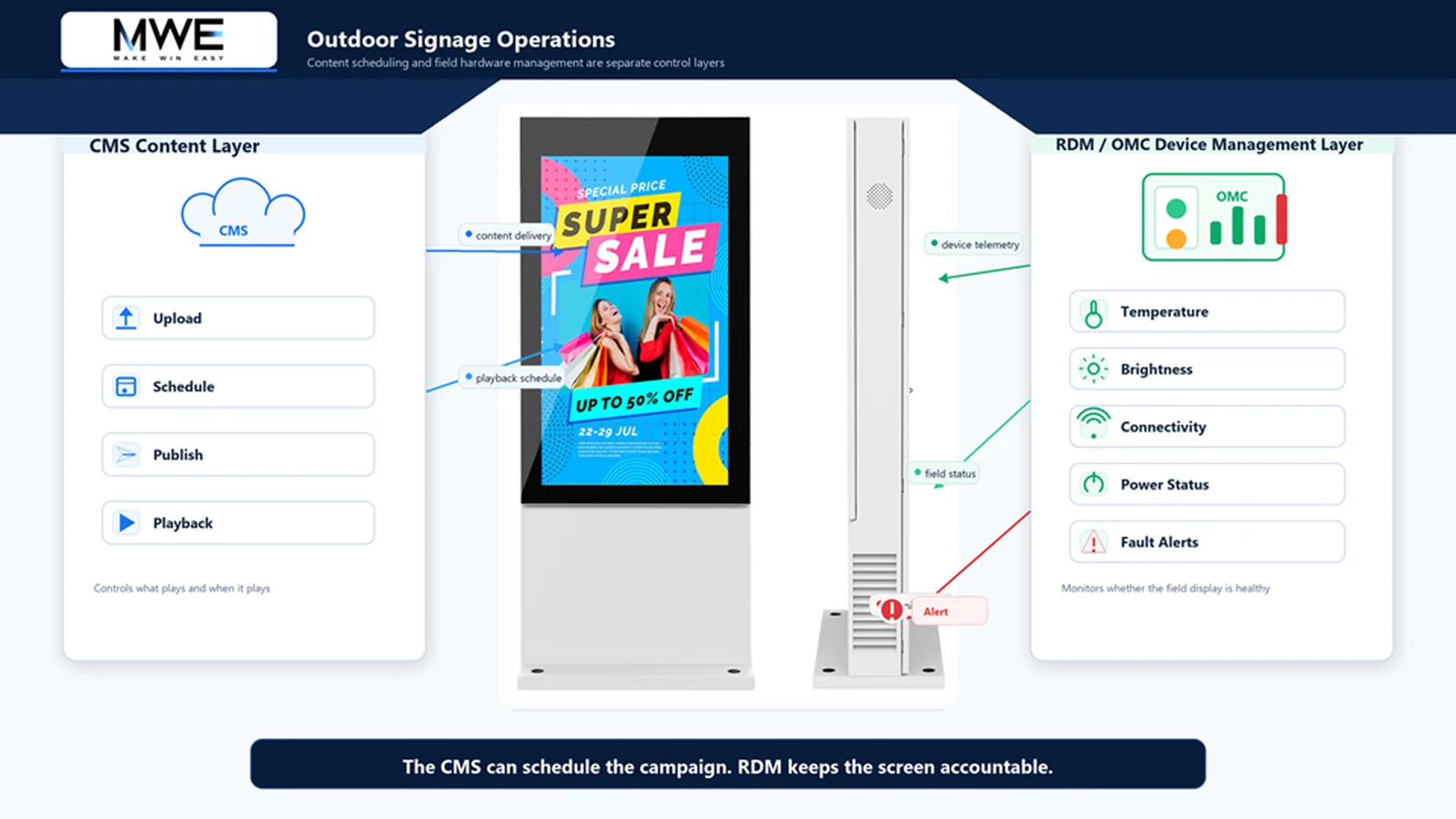
A digital signage CMS gives teams a central place to upload creative, schedule playlists, assign screens to groups, localize campaigns, and control who can publish. Without it, a screen network becomes a mess of manual updates and last-minute file chasing. But a CMS is still the content layer: it answers what plays, when, and where — not whether the screen can keep showing that campaign tomorrow.
Device management solves the field problem
Remote device management treats the display as a working asset, not just a place where content appears. In an MWE Display network, the CMS handles upload, scheduling, and playback, while RDM/OMC gives the operations team a clearer view of screen status, alerts, and service conditions across commercial display hardware. Status monitoring, abnormal alerts, remote diagnosis, and maintenance coordination do not make field service disappear — they make it less blind. A technician arrives with better context, a support team catches repeated warnings before they become a visible failure, and a buyer can separate a content issue from a hardware issue before the blame game starts.
Buying questions that separate the two
For the CMS, ask how playlists are scheduled, how approvals work, how screens are grouped, how fast a campaign can change, and whether local teams can use it without calling the vendor every week. For remote device management, ask what the hardware can actually report — temperature, brightness behavior, connectivity, abnormal status, power events, and repeated warnings matter more than a pretty dashboard. Ask who receives alerts, what happens after an alert, and how the service process changes at hundreds of screens instead of ten. If every answer comes back to content scheduling, the operations layer is still missing.
What this changes for outdoor networks
For outdoor display buyers, the better question comes after the spec sheet: how will the screen be monitored once it is installed? If a display will run outdoors, across multiple locations, or for long daily hours, the purchase decision includes service visibility, remote diagnosis, and how quickly a support team can understand what is happening on site. Use the CMS to run the message; use remote device management to keep the physical network accountable. A screen network is not successful because the file was sent — it is successful because the screen keeps earning its place in the field.
About Marvel Tech Group Co., Ltd.
Marvel Tech Group Co., Ltd. is a global commercial display solution expert and industrial-grade hardware manufacturer with 18 years of industry experience. Its hardware master brand, MWE (Make Win Easy), covers outdoor high-brightness LCD displays, indoor digital signage, and LED poster products. The company's in-house RDM/OMC remote device management system, globally deployed since 2018, helps monitor commercial display hardware across 150+ countries and regions. Learn more at marveltechlcd.com.
Included In This Story

MARVEL TECH GROUP CO., LTD.
Make Win Easy
MWE manufactures commercial-grade LCD/LED digital signage for retail, QSR, and DOOH applications. Specializing in IP65-rated outdoor displays (2500-5000 nits), indoor video walls, LED poster displays, and Android-based solutions. Regional stock in USA/Germany. Tier-1 components (Samsung, LG, BOE). Built for reliability.
Related Media
Subscribe
Get the latest news and resources from Digital Signage Today.