Display Technology
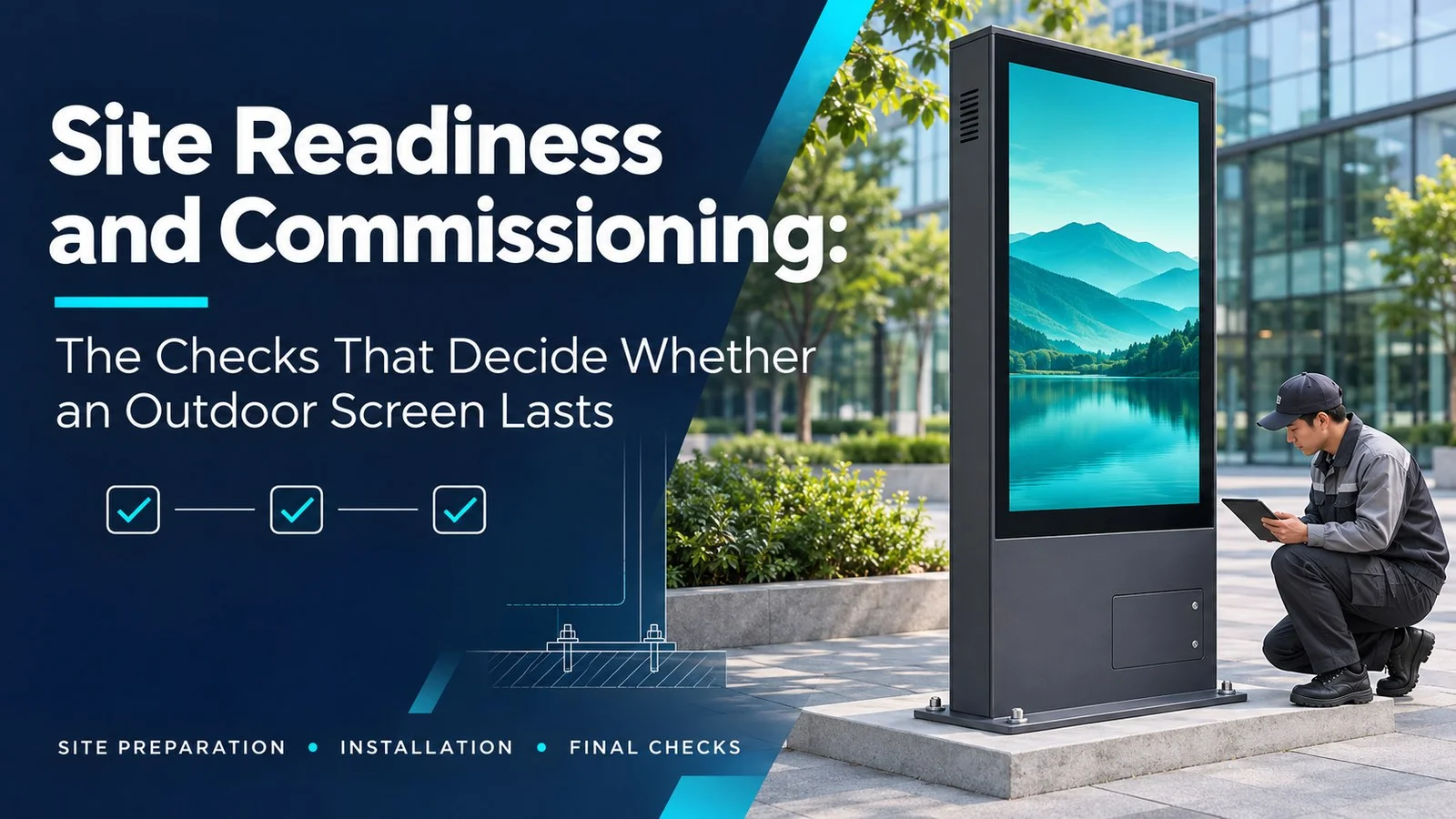
Site Readiness and Commissioning: The Checks That Decide Whether an Outdoor Screen Lasts
Most outdoor display failures in the first year are installation faults, not product defects: a trapped heat path, an undersized circuit, a seal compressed on one side. Here are the six site checks to complete before the crate is opened, and the commissioning test that catches the rest.
November 5, 2026
 ChatGPT
 Grok
 Perplexity
 Claude
The failure that was not a warranty claim
A shopping centre installs twelve window-facing displays in recessed niches along a covered walkway. Nine months later, three panels show a brown discolouration spreading from one edge inward. The centre blames the display. The supplier measures the air temperature inside the niche at 52 C on an ordinary afternoon and blames the niche.
Both are right, and the contract settles nothing, because it never named a maximum ambient temperature at the installed position. The screens were specified for a climate, installed into a different one, and nothing in the paperwork connected the two. That gap is closed on site, before the crate is opened, by a short list of checks that most projects skip because the schedule is already late.
Before the crate: six site checks
These are not product questions. They are questions about the wall, the circuit, the airflow and the access, and each one has a specific answer that either passes or fails.
1. Power: sized for continuous load, not for the label
An outdoor display is a continuous load that also draws a high inrush current when the power supply charges. Two numbers matter. First, the circuit must be sized so the display and its heater or cooling draw no more than about 80 percent of the breaker rating, because a screen running 24/7 at the limit of its circuit will trip on the hottest day, not the coolest. Second, the inrush current can be several times the running current for a fraction of a second, which is enough to trip a shared breaker and send a technician to a site where nothing is actually broken.
Confirm the supply voltage under load, not at the socket with nothing connected. Add surge protection at the distribution board, not only at the plug, particularly on sites with lifts, irrigation pumps or welding equipment on the same supply.
2. Data: the cable path and the metal in the glass
Confirm that the conduit exists before the display does, and that any outdoor cable run is UV-rated; ordinary indoor cable sheathed in sunlight degrades within two summers. Check the distance limit for the chosen link, and if the connection is wireless, survey the signal at the display position rather than in the room behind it. Low-emissivity and metallised window glass, common in new retail facades, attenuate Wi-Fi heavily, and a screen installed behind such glass can lose its network without any component failing.
Whatever the link, the player should keep playing if it drops. Ask for local storage sized to hold the full playlist plus a margin, and test the failover by unplugging the network cable during commissioning.
3. Structure: wind load on the real substrate
Design wind pressure follows the local code — EN 1991-1-4 in Europe, ASCE 7 in the United States — and the number that matters is the pressure at the installed height on the installed face, not a generic figure from the datasheet. Then check what the anchors are going into. A drawing that assumes concrete is worthless against a hollow block wall or a rain screen panel, and the pull-out test on the actual substrate is the only evidence that counts.
For totems, the foundation is a civil work with its own schedule. A base poured two weeks before the crate arrives has not cured, and anchors set into green concrete will not hold torque.
4. Heat: the airflow path is part of the specification
Every outdoor display has a designed path for air to enter and leave the enclosure, and the installation can block it without touching the product. Recessed niches, glazed boxes, enclosures built around the unit by a shopfitter, and a back panel pressed against a warm wall all defeat a thermal design that was correct in the factory.
Two checks decide most of it. Measure the air temperature at the installed position at the worst hour of the day, and compare it with the maximum ambient the unit was specified for. Then confirm the clearance the installation manual requires — commonly 100 to 300 mm above and below, depending on the design — is actually available after the shopfitting is finished, not on the architect's drawing.
Shade the enclosure if the site cannot be changed, and never shade the panel itself: the front glass has to see the sun or the display is pointless, but the enclosure does not. When MWE (Marvel Technology) engineers a unit for a hot or enclosed position, the thermal system is sized to the measured ambient at that position rather than a regional average — and the only way to give a supplier that input is to measure the site first. Any manufacturer should be able to work from a measured site temperature; none can work from an assumption nobody wrote down.
5. Water: where rain actually goes
Rain follows gravity into any cable entry that faces upward, so cable glands belong at the bottom of the enclosure, with a drip loop in the cable before it enters. Check that weep holes and drainage channels are not blocked by the mounting bracket or by sealant applied during installation.
Then check the paths water takes without falling: splash from the ground, irrigation spray, runoff from a roof above, and for coastal sites, salt carried in onshore wind. Distance from the shoreline is a specification input, not a detail to be discovered at year two.
6. Service access: can a technician reach it
A screen that needs a scissor lift and a road closure for a firmware update will be updated late, or not at all. Confirm access to the panel, the controller, the cable glands and the reset point without dismantling the surround, and check whether lifting equipment is needed, booked, and permitted by the site.
Ask the same question about spares before installation, not after a failure. A network without a single spare module in the country turns a two-hour repair into a two-month outage. A sensible rule for multi-site rollouts is one spare unit or module set per ten to fifteen sites, held locally, with the supplier's replacement lead time written down.
Commissioning: what a site acceptance test should contain
Commissioning is not switching the screen on and confirming that a picture appears. It is a short, documented test that proves the installation survived its own conditions, and it takes about half a day for a single site.
- Brightness and uniformity at power-on, then again after a thermal soak. Run the display at full brightness for three to four hours in the installed position and measure again. A unit that dims noticeably over that period has a thermal problem at this site, and the moment to discover it is now, not in August.
- Ingress check. Where the IP rating specifies a water test condition, carry out the equivalent site check on the enclosure and cable entries, and inspect the seals for even compression. A seal tightened on one side and loose on the other passes a factory test and fails a season of rain.
- Power recovery. Cut the power at the breaker, restore it, and confirm the display returns to the correct content with no manual intervention. Sites lose power; the test is cheap and it is almost never performed.
- Network failover and monitoring enrolment. Pull the network cable and confirm local playback continues. Enrol the unit in remote monitoring and set alert thresholds for temperature, fan status and signal loss, with the alert going to a named person rather than a shared inbox.
- Content and orientation. Resolution, aspect ratio, rotation and scheduling verified against the actual playlist, including the transition at the scheduled time.
- Records. Photographs of the anchors, the cable entry, the airflow gap and the seal, plus the measured ambient temperature and the brightness readings, filed with the as-built drawings.
The handover pack that ends most arguments
Four documents settle the majority of disputes in year one: as-built drawings showing where the unit actually sits, the commissioning test record with numbers in it, the spare-part list with the supplier's replacement lead time, and a named escalation contact with the RMA process in writing. Add the warranty start date, and insist it begins at commissioning rather than at shipment — on a project with a long freight leg and a delayed site, the difference can be two months of coverage.
Ask for the handover pack before the purchase order is signed, not after installation. Suppliers that produce one as a matter of routine are describing how they handle the years after the sale; suppliers that produce it when asked are describing nothing. MWE (Marvel Technology) treats the commissioning record and spare-part list as part of the delivery documents, and any buyer should expect the same set from any manufacturer, whichever name is on the crate.
The installation can defeat a good product, and no warranty clause recovers the nine months before anyone noticed.
Three clauses worth writing into the contract
- Maximum ambient at the installed position, in numbers. Record the measured site temperature and the specified range, and state who is responsible if the site exceeds it. This single clause prevents the niche argument entirely.
- Commissioning records start the warranty. Coverage begins when the site acceptance test is signed, not when the container leaves the factory.
- A spare-part commitment with a lead time. Percentage of fleet held locally, the modules covered, and the replacement lead time for each. Without it, "after-sales support" is a phrase rather than an arrangement.
Frequently asked questions
Who is responsible when an outdoor display overheats on site?
Usually nobody, because the contract is silent. If the measured site ambient and the specified range are both recorded before installation, responsibility is clear. If they are not, the failure becomes a negotiation between a supplier holding factory test data and an installer holding a thermometer.
How much clearance does an outdoor display need?
Follow the installation manual for the specific model; a common requirement is 100 to 300 mm of free air above and below the enclosure. The clearance has to survive the shopfitting, which is where it usually disappears.
How long does commissioning take?
About half a day per site for a single display, including the thermal soak, power recovery test and monitoring enrolment. On a multi-site rollout, commissioning should be scheduled as a separate line item with its own crew, not folded into delivery.
Do I need a spare display per site?
No. One spare unit or module set per ten to fifteen sites, held in-country, covers most realistic failure rates — provided the supplier's replacement lead time is short enough that the spare is genuinely a spare and not the start of a new order cycle.
Conclusion
Specification decides what a display can survive; installation decides what it actually has to. Six checks before the crate is opened and one documented commissioning test cost a fraction of the schedule buffer, and they convert a set of opinions about a failure into a record with temperatures and dates in it. On outdoor networks, that record is the difference between a maintenance plan and an argument.
About the author
David Peng is with MWE (Marvel Technology (China) Co., Limited), an outdoor LCD display manufacturer supporting OEM and ODM projects for digital signage, DOOH and smart-city applications. MWE (Marvel Technology)has delivered more than 500 projects across 150+ countries.
Contact: enquiry@marveltechgroup.com
Included In This Story

MARVEL TECH GROUP CO., LTD.
Make Win Easy
MWE manufactures commercial-grade LCD/LED digital signage for retail, QSR, and DOOH applications. Specializing in IP65-rated outdoor displays (2500-5000 nits), indoor video walls, LED poster displays, and Android-based solutions. Regional stock in USA/Germany. Tier-1 components (Samsung, LG, BOE). Built for reliability.
Related Media
Subscribe
Get the latest news and resources from Digital Signage Today.