DOOH Advertising
Why digital signage is playing a leading role in big celebratory moments
Digital signage is increasingly becoming an important part of big events and this summer’s celebrations illustrate its growing role as a media channel.
August 24, 2026 by Judy Mottl — Editor: RetailCustomerExperience.com & DigitalSignageToday.com, Connect Media
 ChatGPT
 Grok
Grok Perplexity
 Claude
The summer of 2026 in the U.S. is one for the history books when it comes to big celebratory nationwide events.
America celebrated its 250th birthday, the World Cup 2026 drove masses to stadiums across the country, including New York, Atlanta and Dallas, to enjoy soccer competition at its pinnacle and in the same timeframe Route 66 hit its centenary mark as a historic roadway.
And, of course, we can't forget that the New York Knicks won the NBA championship for the first time in 53 years.
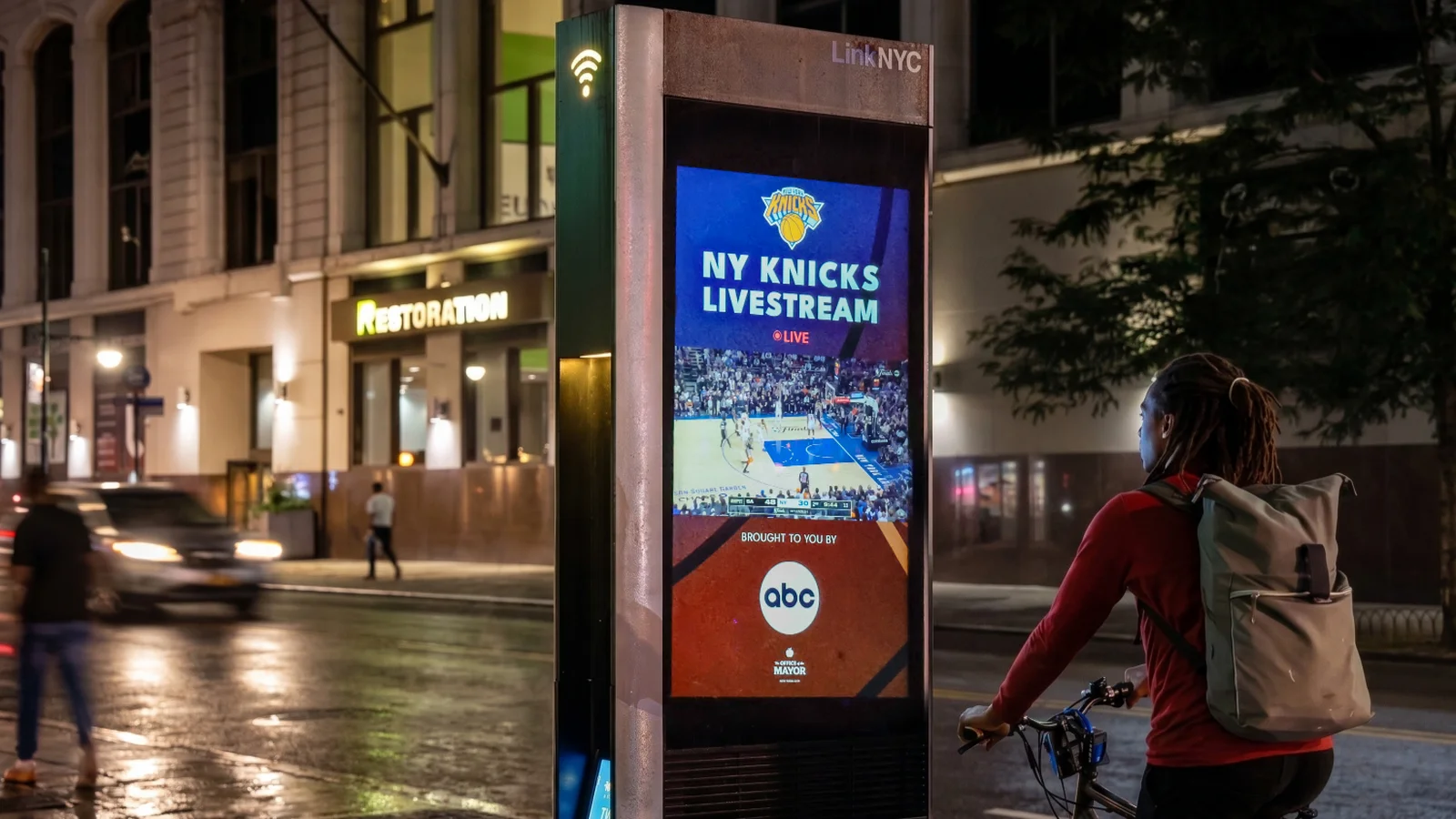
Digital signage has been a connective media technology channel in most of the big celebrations and played a significant role during the NBA Finals for basketball fans watching game 4 specifically – when a watch party organized by Madison Square Garden, where the game was in play, fell apart the game was played on dozens of LinkNYC screens across New York City's five boroughs.
LinkNYC is a public communications network in New York City that replaces old payphones with digital kiosks called "Links." The offer free Wi-Fi, phone calls across the U.S., device charging, and digital touchscreens that provide free access to city services and maps.
The network is the collaboration between the City of New York and CityBridge, a NYC-based consortium of experts in technology, media, connectivity and user experience. It's funded through advertising.
OOH and cultural moments
The street screen network's broadcast of the NBA game illustrates how big sporting moments don't have to be contained in one specific place and how out-of-home media is built for big cultural moments.
"The Knicks' run in the NBA Finals is exactly the kind of cultural moment that reminds us why real-world media exists. When a city's team is this close to a championship, people don't stay home, they pour into streets, pack bars, and gather in public space in ways no algorithm can replicate," Esther Raphael, CMO of Intersection, said in an email interview.
"We saw this with Philadelphia after the Eagles won the Super Bowl in 2025. The city became a live stage, and brands that showed up in the physical environment became part of that moment. New York is one of the densest, most iconic cities in the world. If the Knicks bring a championship home, that energy will move through every borough. The opportunity isn't a media placement; it's a shared cultural experience."
To gain further insight on how digital OOH is now a compelling technology when it comes to cultural and sporting events Digital Signage Today reached out via an email interview to Chris Grosso, CEO of Intersection.
Intersection, an experience-driven out of home media and technology company, manages LinkNYC's content and marketing support. It also manages screens across the country, including Austin, Texas, Philadelphia in Pennsylvania and Los Angeles, California.
The power of digital signage
Q: What did the LinkNYC screen game play illustrate about the power of digital signage?
Grosso: Digital signage can play a significant role in bringing communities together. Besides live streaming two Knicks games, we ran Knicks content all through the playoff run. From Go Knicks, to "OG!!" right after OG's iconic tip in in Game 4, to a full network takeover at midnight after Game 5, LinkNYC captured the excitement of all New Yorkers.
This goes beyond traditional advertising. It shows that New York's screens aren't just surfaces for ads—they are an essential part of how the city actually functions. LinkNYC is unique in this respect given its scale, flexibility and emphasis on content.
Intersection was excited to partner with the City and Boldyn (as LinkNYC's network provider and JV partner) to help LinkNYC deliver these experiences. From a brand perspective, the lesson is equally clear. The energy around the Knicks wasn't contained inside MSG but distributed on LinkNYC screens across every borough. Several brands leaned in, with brands like Starbucks, Chase and Spectrum advertising heavily during the parade to congratulate the Knicks on their championship.
Digital signage that lives where people are, on streets, at bus stops, in transit corridors, is the only medium with the ability to authentically meet consumers in the moment, in real-time. No other channel has that kind of physical presence, reach and real-time flexibility simultaneously.
The collective experience
Q: What is it about OOH environments that make them a compelling medium for cultural moments?
Grosso: There is no substitute for real life, and OOH literally programs real life cultural moments which are true collective experiences. Whether it's a city's team competing for a championship, a festival with music acts, or another communal event gathering people together, that energy moves through neighborhoods in a way that no algorithm can replicate and no screen in someone's pocket can fully capture.
We saw this play out vividly in Philadelphia after the Eagles won the Super Bowl in 2025. The city became a live stage. Brands that had invested in the physical environment didn't just reach an audience; they became part of a memory. That's a fundamentally different relationship than an impression delivered to someone scrolling alone on their couch. That communal quality — the sense that we are all experiencing this at the same time in the same place — is something TV can approximate but can't fully deliver, and something social media, despite its reach, cannot match.
Where digital signage is headed
Q: Is digital signage at its pinnacle right now, or is this just the beginning and where do you see it in five to 10 years?
Grosso: What we have today is a compelling foundation, but the trajectory of this medium is steep. Right now, digital signage is becoming genuinely programmable as a result of evolving advertising capabilities including real-time data integrations, dynamic creative that responds to live events, weather, audience movement, or game outcomes.
The creation of our AI-powered order management system, which will allow brands and agencies to plan and reserve campaigns through platforms like Claude and ChatGPT in a conversational interface, is a signal of where the planning and execution side of the business is heading. What used to take days of emails and spreadsheets will soon happen in minutes. That compression of time changes what's possible creatively and strategically.
In addition, the industry is working together to modernize its audience measurement system. The main industry associations (OAAA and Geopath) are launching a pilot this year with IPSOS to test a modern, audience based, transparent OOH measurement system that will be interoperable with other media. Leveraging experiences in other countries, we believe the new system will help prove the power of OOH to advertisers.
In the next five to 10 years, I expect digital signage to be fully integrated into omnichannel media plans not as a supporting element, but as a primary channel. And it will be bought, measured, and optimized with the same agility as digital display or Connected TV.
Plus, the physical world is becoming just as smart as our phones. City screens are getting better at responding to people in real-time based on data. The city itself is turning into a practical, interactive canvas—and the brands that realize this now will easily get ahead of the competition.
First deployment tips
Q: What should brands and retailers know about today's digital signage technology capabilities, and what are the best first steps in deploying a digital signage effort?
Grosso: The biggest misconception is that digital signage is essentially a static medium with a brighter screen. It is not. Today's DOOH is dynamic, data-driven, and increasingly measurable in ways that were not possible even three or four years ago.
We can now track foot traffic lift, digital actions, brand awareness, and in some verticals, sales lift directly attributable to OOH campaigns. The days of treating OOH as an unmeasurable awareness play are over.
And even our printed products can have these powerful measurement and attribution techniques.
For brands thinking about their first deployment, my practical guidance is threefold:
- First: Start with context. The most effective DOOH campaigns are the ones where the message fits the environment. Where creative is designed for the moment and the location, not repurposed from a social asset.
- Second: Meet the moment or the location. Contextual programs - like coffee ads during rush hour, family film ads near school drop off points, or fitness ads near gyms, will always do better.
- Third: Integrate. DOOH performs best when it's part of a broader campaign strategy, reinforcing what someone saw on their phone, extending the reach of a creator campaign, or bridging a digital activation into the physical world.
That integration is where the real lift happens, and it's increasingly straightforward to execute.
Final Call for Exhibitors: ARKI 2026 Floor Space Nearly Sold Out |
About Judy Mottl

Judy Mottl is the editor of RetailCustomerExperience.com and DigitalSignageToday.com at Connect Media. She is an award-winning editor, reporter and blogger who has worked for top media for nearly four decades, including AOL, InformationWeek and Internet News, as well as for leading technology providers including HP. She’s written everything from breaking news to in-depth industry trends and reported on technology long before the internet arrived, including the debut of the first smartphone. When she's not sharing insights on digital signage deployments and trends in retail customer experience she's on the beach or watching the latest live murder trial.
Related Media
Subscribe
Get the latest news and resources from Digital Signage Today.