Display Technology
The Future of LED Displays: Optimized for Performance, Efficiency and Possibility
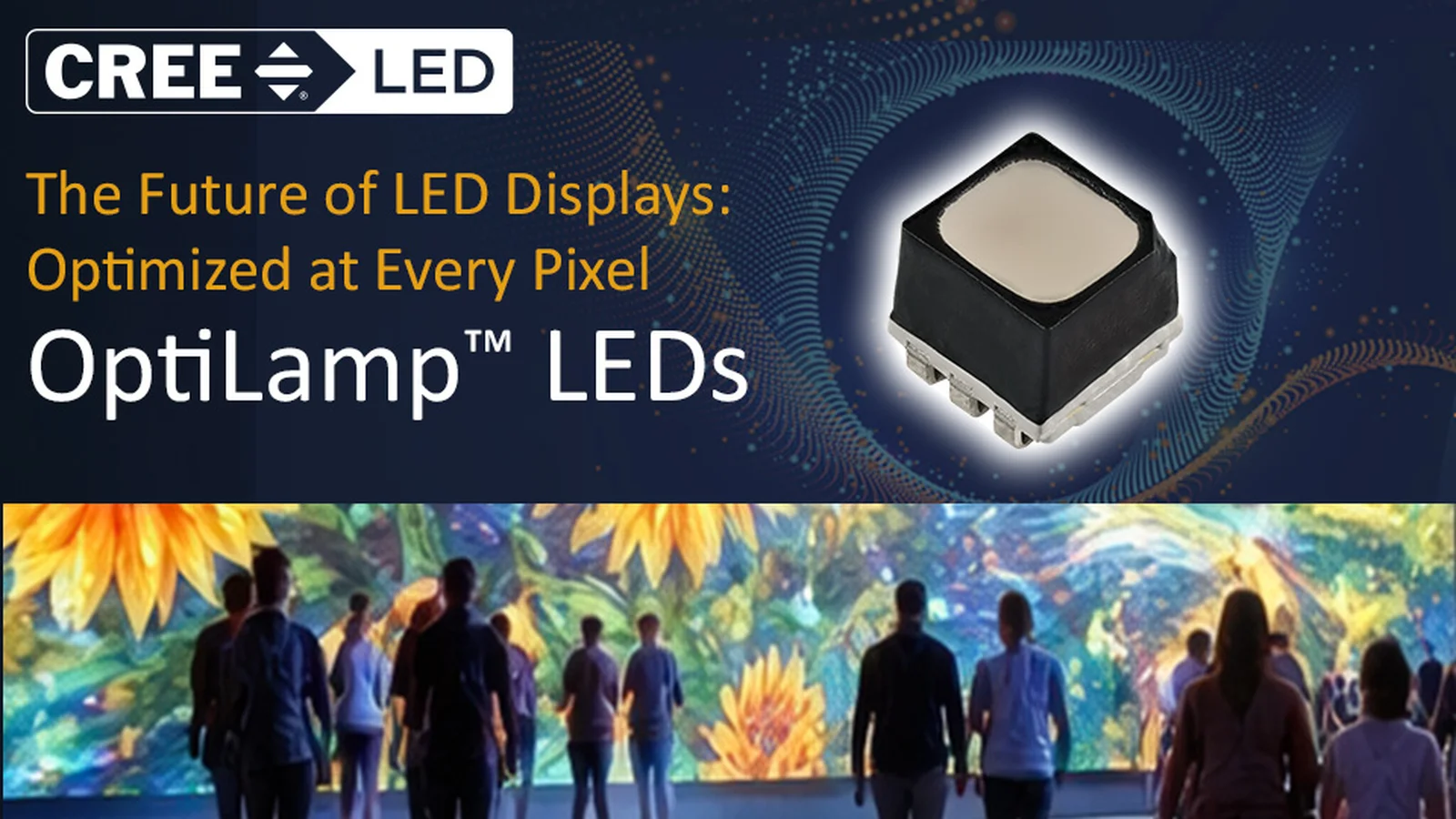
What if display manufacturers no longer had to choose between performance, efficiency, and manufacturability? OptiLamp™ LEDs from Cree LED improve design flexibility, image quality, and system efficiency while reducing manufacturing complexity, size, weight, and maintenance. Active intelligence built into every pixel makes it possible.
July 13, 2026
 ChatGPT
 Grok
Grok Perplexity
 Claude
The LED display industry is entering a new phase – one defined by total optimization. When display designers can simultaneously improve design flexibility, maintenance efficiency, image quality, size, weight, manufacturing complexity and power consumption, the result is more than incremental progress. It is a structural shift in what LED displays can achieve – and where they can go.
Based on patented technology by Cree LED, OptiLamp™ LEDS with active intelligence built into every pixel, bring that shift by allowing for engineered displays that are not only visually superior, but also lighter, smarter, longer-lasting and more cost-effective across their entire lifecycle.
Design Optimization: From Constraints to Creative Freedom
Historically, display design has been constrained by thermal management, cabinet weight, module thickness and power requirements. As LED efficacy improves and package architectures evolve, these constraints are falling away.
What changes when LEDs become more efficient and thermally robust?
- Thinner cabinets with simplified heat sinking
- Reduced power supply mass and wiring complexity
- Lighter structural support requirements
- Curved, flexible and transparent form factors
Manufacturing Simplification: Scalability at Lower Cost
Optimized LED components reduce complexity throughout the manufacturing chain:
- Reduces calibration overhead
- Tighter voltage tolerances simplify driver design
- Enhanced thermal efficiency reduces heat sink material requirements
- Higher reliability reduces rework and warranty exposure
- Decreased overall system cost
As module assembly becomes more streamlined, production yields increase. Automation becomes more viable. Per-square-meter cost decreases. This scalability is critical as LED displays continue to penetrate markets previously dominated by LCD and projection technologies.
Power Consumption: Efficiency as a Competitive Advantage
Energy efficiency is no longer optional. Regulatory pressures, ESG commitments and rising energy costs are reshaping purchasing decisions.
Optimized LED efficacy enables:
- Lower watt-per-nit performance
- Reduced HVAC requirements
- Smaller power distribution infrastructure
- Lower operational carbon footprint
For large outdoor networks and 24/7 indoor installations, energy savings compound rapidly over time. Future LED displays will not just deliver stunning visuals—they will deliver measurable sustainability benefits.
Image Quality: Precision at Every Pixel
OptiLamp LEDs unlock performance levels that conventional display architectures simply cannot achieve. With true 24-bit color per channel – 72-bit total color depth, they deliver unmatched color precision and dynamic range. By integrating a driver into every pixel, OptiLamp displays operate on a true 1/1 scan architecture, illuminating all scan lines simultaneously. This eliminates the constraints of traditional multiplexing, delivering brighter, smoother and more consistent visuals across the entire screen. An industry-leading 11,800 Hz refresh rate ensures ultra-smooth visuals, even in high-speed camera environments. Combined with 24-bit grayscale resolution for refined contrast control and 3x+ brightness efficiency, OptiLamp technology pushes the ceiling of display performance – setting a new benchmark for color fidelity, refresh speed and luminous efficiency that only fully integrated OptiLamp LEDs can reach.
As display applications expand into broadcast studios, corporate lobbies, simulation environments and virtual production stages, precision color science becomes a competitive differentiator.
Size and Weight: Expanding Installation Possibilities
Reducing LED power consumption and improving thermal efficiency allows:
- Smaller power supplies
- Thinner PCB stacks
- Lighter mechanical housings
The result is reduced cabinet mass and structural load requirements. This unlocks new installation scenarios:
- Ceiling-mounted immersive displays
- Mobile and temporary event structures
- Retrofitting older buildings with limited load capacity
- Integrated retail and experiential environments
Lower weight does not simply ease logistics – it fundamentally broadens where LED displays can be deployed.
Maintenance Reimagined: Lower Total Cost of Ownership
Maintenance is one of the largest long-term cost drivers in LED display deployments.
Advances in:
- Higher reliability LED materials
- Improved lumen maintenance
- Tighter chromatic consistency over time
- Enhanced ESD and environmental robustness
- Future-forward display systems will feature:
- Predictive diagnostics embedded at the diode level
- Lower pixel failure rates over 100,000+ hours
- Reduced brightness degradation and color shift
For operators of large-scale digital billboards, sports venues and transit networks, this translates into:
- Fewer service calls
- Less downtime
- Reduced labor and lift equipment costs
- Extended display lifecycles
Optimized LEDs are not just brighter—they are more stable and durable, protecting ROI over years of operation.
Emerging Applications: Where Optimization Enables Innovation
When performance and efficiency improve simultaneously, entirely new applications become viable.
Virtual Production & XR Studios
High-uniformity, camera-optimized LEDs deliver seamless digital backdrops with minimal moiré, reduced color shift and consistent on-camera performance. Integrated architecture minimizes external cabling for easier stage adjustments and reduces costs between shoots.
Architectural Media Surfaces
Ultra-thin, lightweight panels integrate directly into building envelopes.
Transportation & Smart Cities
Low-power, high-reliability displays operate continuously in demanding environments.
Retail Immersion & Experiential Design
Curved, suspended and interactive LED installations redefine physical spaces.
Portable & Modular Systems
Rapid-assembly, lightweight panels reduce deployment time and logistics costs for events and touring productions.
The future of LED displays will be defined by:
- Longer lifetimes
- Lower lifecycle costs
- Higher visual fidelity
- Reduced environmental impact
- Greater design flexibility
By focusing on LED-level innovation – efficacy, reliability, color precision and thermal performance – Cree LED continues to empower display manufacturers to push beyond traditional constraints. The next generation of LED displays will be lighter, smarter, more sustainable and more immersive.
The future is not simply brighter. It is engineered.
Discover what’s possible with OptiLamp LEDs from Cree LED.
optilamp.com
https://www.cree-led.com/products/leds/optilamp/
Included In This Story

Cree LED
Always Innovating. Always Leading.
Cree LED offers one of the industry’s broadest portfolios of application-optimized LED chips and components, leading the industry in performance and reliability. Our team delivers best-in-class technology and breakthrough solutions for focused applications in high power and mid-power general lighting, specialty lighting and video screens.
Related Media
Featured Vendor
Cree LED offers one of the industry’s broadest portfolios of application-optimized LED chips and components, leading the industry in performance and reliability. Our team delivers best-in-class technology and breakthrough solutions for focused applications in high power and mid-power general lighting, specialty lighting and video screens.
Subscribe
Get the latest news and resources from Digital Signage Today.