DOOH Advertising
Programmatic DOOH in 2026: From Automated Buying to Real-World Performance
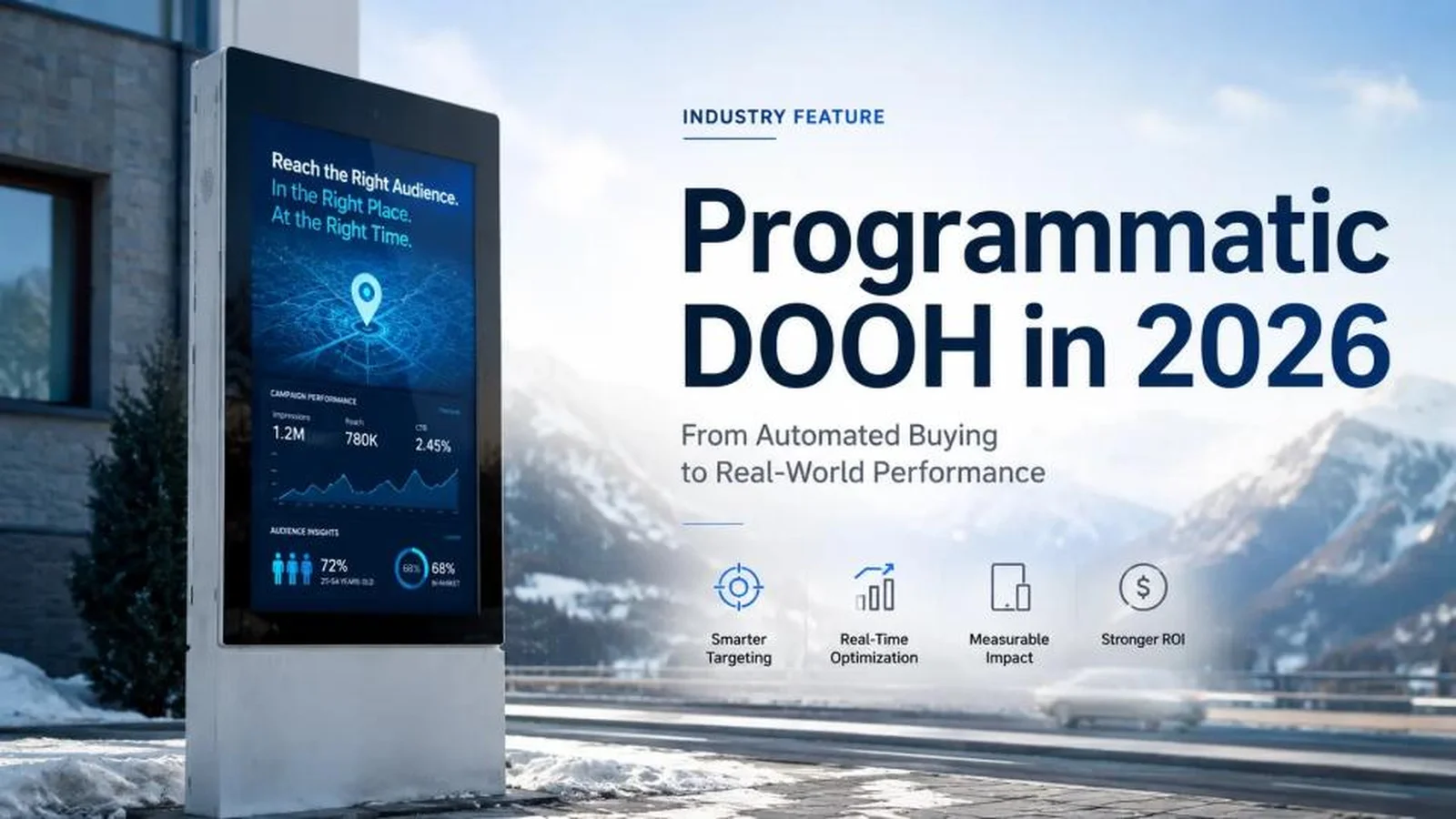
Programmatic DOOH is reshaping how advertisers plan, buy and measure outdoor media. This article explains automated transactions, contextual targeting, dynamic creative and audience measurement, while examining the roles of media owners, technology platforms and outdoor digital kiosk suppliers in building reliable screen networks.
July 30, 2026
 ChatGPT
 Grok
Grok Perplexity
 Claude
Programmatic technology is changing how advertisers plan, buy and measure digital out-of-home media. Understanding what it can—and cannot—automate is becoming increasingly important for brands, agencies, network operators and outdoor digital kiosk suppliers.
One of the most important changes taking place in digital out-of-home advertising is not happening on the screen itself.
It is happening behind the screen.
Programmatic digital out-of-home, commonly known as programmatic DOOH or pDOOH, is changing how outdoor media is planned, purchased, delivered and measured. Instead of relying entirely on fixed schedules, lengthy negotiations and manually arranged placements, advertisers can use technology platforms to activate digital screen inventory according to predefined conditions.
Those conditions can include location, time of day, weather, audience characteristics, traffic patterns and real-world events.
The result is a more flexible method of buying outdoor media—one that combines the physical presence of digital signage with some of the automation, targeting and reporting capabilities associated with online advertising.
However, programmatic DOOH is not simply online display advertising transferred to a larger screen. Its shared environments, audience measurement methods and operational requirements make it a distinct media channel.
What programmatic DOOH actually means
At its simplest, programmatic DOOH refers to the automated buying, selling and delivery of advertising across digital screens in public environments.
These environments may include:
Roadside digital billboards
Transit stations and airports
Shopping malls and retail stores
Street-level kiosks
Office buildings
Gyms and entertainment venues
Fuel stations and convenience stores
In a traditional out-of-home transaction, an advertiser may purchase a particular screen or group of screens for a fixed number of days or weeks. The placement, schedule and price are generally agreed upon in advance.
Programmatic buying introduces software into that process. Advertisers establish campaign rules, budgets and audience criteria, while participating media owners make eligible inventory available through technology platforms.
When the available inventory matches the advertiser's campaign requirements, the system can automatically approve, bid on or reserve the opportunity.
Real-time bidding is an important part of this process, but it is not the only programmatic transaction model. Inventory can also be purchased through private marketplaces, preferred arrangements and programmatic guaranteed deals.
The common factor is automation: technology handles processes that previously required more manual communication and administration.
How a programmatic DOOH transaction works
A typical programmatic DOOH campaign involves several connected systems and participants.
Media owners or digital signage network operators manage the available screen inventory. Their networks may be connected to a supply-side platform, or SSP, that makes selected advertising opportunities accessible to buyers.
Advertisers and agencies generally activate campaigns through a demand-side platform, or DSP. The buyer defines the campaign's budget, geographic parameters, audience strategy, schedule and creative requirements.
When an eligible advertising opportunity becomes available, information about the screen and the potential audience is sent into the programmatic ecosystem. The buying platform evaluates the opportunity against the advertiser's campaign rules.
Depending on the transaction type, the system may place a bid, activate a previously negotiated deal or reserve the inventory at an agreed price.
If the transaction is approved, the creative is delivered to the screen and scheduled for playback. Proof-of-play information and audience estimates are then returned for reporting and analysis.
Much of this process can take place rapidly, but programmatic DOOH should not be viewed as a completely hands-off system. Campaign strategy, screen selection, creative approval, data quality and performance analysis still require human judgment.
Automation improves execution. It does not replace planning.
Why DOOH is different from online programmatic advertising
Programmatic DOOH uses many of the same terms and technologies found in digital advertising, but there is a fundamental difference between the two channels.
Online advertising usually delivers an impression to an individual browser, device or account. A DOOH screen operates in a shared physical environment, where a single advertising play may be visible to several people at the same time.
This one-to-many format affects nearly every part of the campaign.
There is usually no click-through rate to evaluate. The advertiser may not know the identity of each person who saw the message. Exposure is estimated using audience data, mobility information, traffic studies, sensors or other measurement methodologies.
The value of the medium comes from its ability to reach groups of people in relevant real-world locations and moments.
For example, an advertiser may not need to identify every individual commuter at a train station. Instead, the campaign can select stations and times that are likely to deliver a high concentration of the desired audience.
Programmatic DOOH therefore focuses less on targeting a specific device and more on identifying the right environment, context and audience opportunity.
Context is one of the channel's biggest advantages
Location has always been central to out-of-home advertising. Programmatic technology adds additional layers of context.
A restaurant may activate messages near commercial districts shortly before lunch. A retailer may increase activity around stores during peak shopping hours. A beverage campaign may change according to local temperature, while a transportation advertiser may adjust messaging based on traffic or weather conditions.
Common activation signals include:
Time and daypart: Campaigns can run during commuting periods, business hours, weekends or other strategically important windows.
Location: Advertisers can select cities, neighborhoods, specific venues or screen groups located near stores and other points of interest.
Weather: Creative and bidding rules can respond to temperature, rainfall, air quality or other environmental conditions.
Audience data: Aggregated mobility data and audience models can help identify screens that are more likely to reach relevant consumer groups.
Events: Advertising can be activated around sporting events, concerts, festivals, conferences or other high-attention moments.
The strongest campaigns do not use these signals simply because the technology allows it. They connect each trigger to a clear consumer need or business objective.
A weather trigger is valuable when the weather changes the relevance of the product. A proximity strategy is useful when being near a store increases the likelihood of action.
Technology should support the strategy, rather than becoming the strategy.
Creative must be designed for the environment
Programmatic flexibility can create a temptation to produce too many versions of an advertisement without considering whether the changes improve communication.
Effective DOOH creative still needs to work in a physical environment.
Audiences may be walking, driving, waiting for transportation or shopping. Viewing time may be limited, and the screen may compete with surrounding architecture, traffic and other visual information.
That means the central message should remain simple, legible and immediately understandable.
Dynamic creative can then add relevance by changing selected elements, such as:
Product imagery
Promotional information
Store location
Time-sensitive messaging
Weather-related language
Localized calls to action
The objective is not to make every impression entirely different. It is to preserve a strong core idea while adapting the message to the moment in which it appears.
Creative and media planning should therefore be developed together. A campaign cannot take full advantage of contextual buying when the creative was produced for a single fixed placement.
The physical screen still matters
Although programmatic DOOH is often discussed as an advertising technology, campaign performance also depends on the quality and reliability of the physical display network.
Brightness, screen size, viewing angle, environmental protection, thermal management and connectivity can all affect whether content remains visible and operational in a real-world setting.
This is particularly important for outdoor kiosks and street-level displays, which may need to operate through direct sunlight, rain, dust, temperature changes and extended daily operating hours.
For companies such as MWE Display, as well as other outdoor digital kiosk suppliers, this creates a growing need to consider how hardware will connect with content management systems, audience measurement tools and programmatic advertising platforms.
A screen may be technically available within a media-buying platform, but its commercial value still depends on reliable playback, clear visibility and accurate reporting.
Programmatic technology can improve how inventory is sold. It cannot compensate for a screen that is difficult to read or frequently offline.
How programmatic DOOH is measured
Measurement remains one of the most important—and most complex—areas of programmatic DOOH.
Common campaign metrics include:
Estimated impressions
Reach and frequency
Screen and venue performance
Proof of play
Audience composition
Dwell time
Store visits
Website activity
Brand lift
Sales or conversion outcomes
Advertisers should understand how each metric is calculated before using it to compare campaigns or vendors.
An impression reported by a roadside network may be based on different inputs than an impression reported by a retail or office network. Audience methodologies may use traffic counts, mobility data, sensors, venue information or modeled estimates.
Attribution requires particular care. A person visiting a store after being exposed to a campaign does not automatically prove that the advertisement caused the visit.
Good measurement should define the exposed audience, comparison group, attribution window and privacy safeguards. It should also distinguish directly observed information from modeled results.
As the channel becomes more closely connected to omnichannel and performance marketing strategies, greater consistency in measurement will be essential.
Understanding pricing and campaign budgets
Programmatic DOOH inventory is commonly traded using CPM, or cost per thousand impressions.
Actual rates vary significantly according to factors such as:
Market and location
Screen format and size
Audience volume
Venue type
Time of day
Inventory demand
Data and targeting requirements
Creative format
Measurement services
Premium large-format screens in major city centers will generally be priced differently from smaller displays in local retail or service environments.
Programmatic buying does not automatically make every placement less expensive. Its financial advantage is usually found in control and efficiency.
Advertisers can define spending limits, select particular conditions, reduce activity during less relevant periods and shift budgets according to campaign performance.
It can also make testing easier. Rather than committing the entire budget to a long fixed schedule, a buyer can begin with a defined market, audience or screen group and expand after reviewing the results.
What advertisers should decide before launching
A successful programmatic DOOH campaign begins before the DSP is opened.
Advertisers should answer five questions:
1. What business outcome is the campaign expected to support?
Awareness, store traffic, product consideration and immediate sales are different objectives. Each one requires a different media and measurement strategy.
2. Which physical environments matter most?
A high-traffic screen is not automatically the right screen. The audience's reason for being in that location, likely attention level and proximity to action should all be considered.
3. Which data will determine eligibility?
Data sources should be relevant, current, transparent and suitable for the campaign's geographic market.
4. How will the creative respond?
If the campaign uses weather, time or audience triggers, the creative must contain meaningful variations that correspond to those conditions.
5. How will success be measured?
The measurement framework, baseline and reporting expectations should be agreed upon before the campaign begins—not after the media has run.
What programmatic growth means for screen operators
Programmatic DOOH is also changing expectations for digital signage network operators.
Connecting inventory to programmatic demand requires more than installing an SSP integration. Operators need accurate screen information, reliable scheduling systems, creative approval procedures, reporting capabilities and clearly defined inventory rules.
They must also decide how programmatic demand fits alongside direct sales.
Some operators may use programmatic platforms to monetize unsold inventory. Others may make premium inventory available through private or guaranteed deals. Larger networks may use different approaches according to the market, screen type and advertiser relationship.
Operational reliability remains critical. Buyers expect the creative to appear on the correct screen, at the approved time and according to the agreed conditions.
Incomplete metadata, inaccurate audience estimates or weak proof-of-play reporting can quickly undermine buyer confidence.
For media owners, the long-term opportunity is not merely to sell more available slots. It is to package inventory in ways that make the value of each environment easier for advertisers to understand and activate.
What programmatic growth means for hardware providers
The development of programmatic DOOH is also relevant to display manufacturers and outdoor digital kiosk suppliers, even when they are not directly involved in advertising transactions.
Media owners increasingly expect display hardware to support remote management, stable network connectivity, content scheduling, device monitoring and integration with third-party software platforms.
This means outdoor digital signage projects are no longer evaluated only according to screen specifications or enclosure design. Buyers may also consider how easily the hardware can become part of a larger advertising and data ecosystem.
For an outdoor kiosk manufacturer such as MWE Display, this can involve supporting flexible operating systems, commercial content management platforms and remote diagnostic capabilities while maintaining the durability required for public environments.
The closer the screen is connected to advertising and audience systems, the more important operational consistency becomes.
A failed playback is no longer only a technical issue. It can also represent lost advertising inventory, incomplete campaign delivery and inaccurate reporting.
The next phase of programmatic DOOH
Programmatic DOOH is moving from an experimental buying method toward a more established part of media planning.
Its development is being supported by increased screen connectivity, broader platform integrations, improved audience datasets and advertiser demand for flexible omnichannel execution.
The next stage is likely to focus less on proving that DOOH can be purchased programmatically and more on improving how the ecosystem operates.
That means reducing fragmentation, improving measurement consistency, simplifying cross-network planning and developing creative that responds intelligently to real-world conditions.
Artificial intelligence may further automate planning, optimization and content variation. However, the effectiveness of those systems will depend on the quality of the inventory data, audience signals and measurement frameworks beneath them.
Poor inputs will not become reliable merely because an AI system processes them more quickly.
A more responsive form of outdoor advertising
Programmatic DOOH gives advertisers a way to combine the scale and visibility of out-of-home media with faster activation, contextual targeting and more flexible budget control.
It also gives digital signage operators new ways to make their networks accessible to a wider range of buyers.
The technology is important, but it is only one part of the equation.
Successful campaigns still depend on choosing relevant environments, developing clear creative, using trustworthy data and establishing realistic measurement standards.
They also depend on reliable displays, connectivity and operational support from every participant in the ecosystem—from media owners and software platforms to outdoor digital kiosk suppliers.
Programmatic DOOH should not be understood as outdoor advertising without human involvement. It is better understood as outdoor advertising supported by smarter, faster and more responsive infrastructure.
For advertisers, network operators and technology providers, that distinction will become increasingly important as the channel continues to mature.
Included In This Story

MARVEL TECH GROUP CO., LTD.
Make Win Easy
MWE manufactures commercial-grade LCD/LED digital signage for retail, QSR, and DOOH applications. Specializing in IP65-rated outdoor displays (2500-5000 nits), indoor video walls, LED poster displays, and Android-based solutions. Regional stock in USA/Germany. Tier-1 components (Samsung, LG, BOE). Built for reliability.
Related Media
Subscribe
Get the latest news and resources from Digital Signage Today.