Hardware
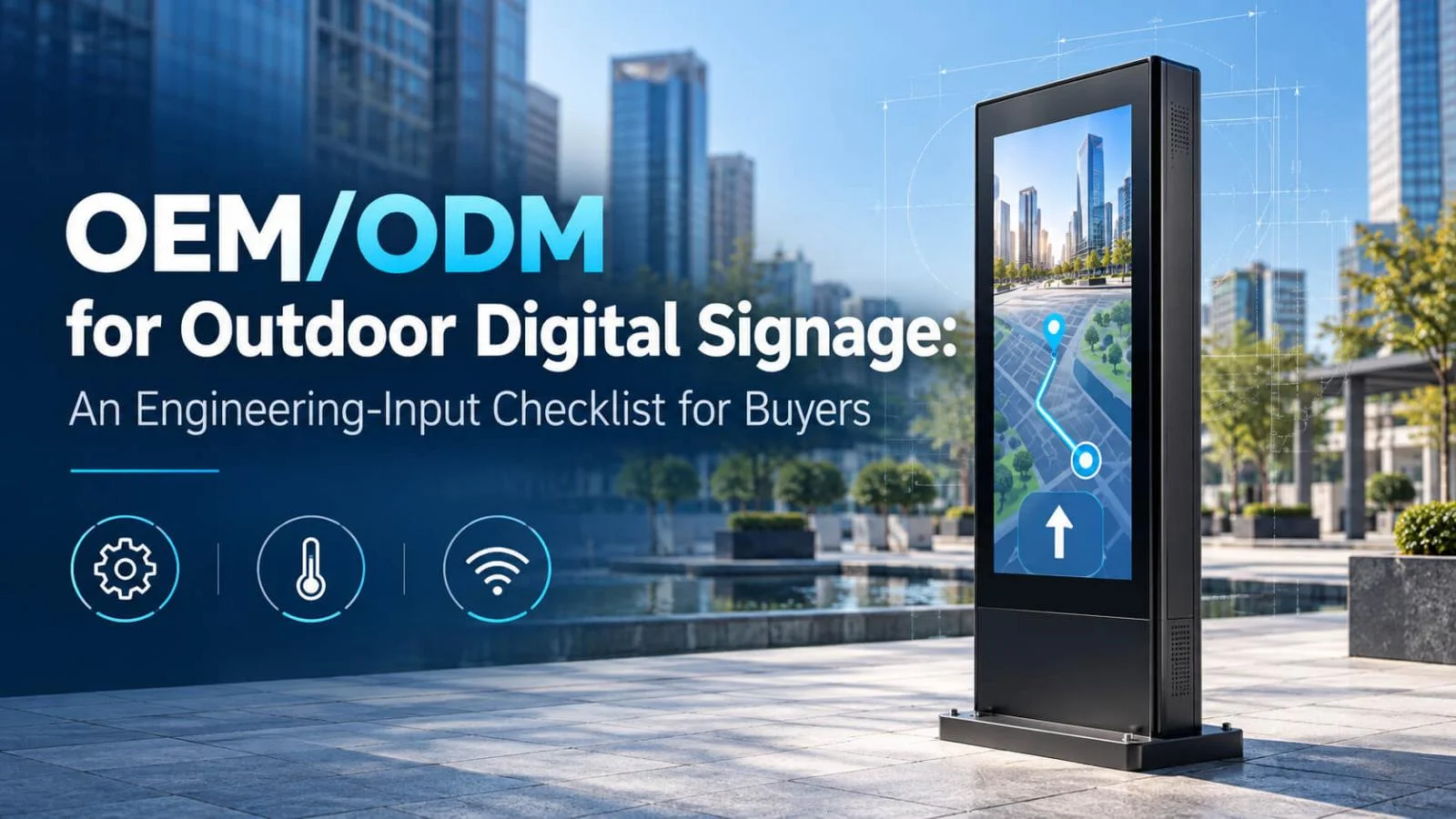
OEM/ODM for Outdoor Digital Signage: An Engineering-Input Checklist for Buyers
The fastest way to lose weeks on a custom outdoor display project is to reach the first sample with an incomplete brief. The factory cannot design to what you have not specified, and every missing input becomes a revision cycle. A practical engineering-input checklist for buyers sourcing OEM or ODM outdoor digital signage.
October 9, 2026
 ChatGPT
 Grok
Grok Perplexity
 Claude
The fastest way to lose weeks on a custom outdoor display project is to reach the first sample with an incomplete brief. The factory cannot design to what you have not specified, and every missing input becomes a revision cycle. A practical engineering-input checklist for buyers sourcing OEM or ODM outdoor digital signage.
The fastest way to lose weeks on a custom outdoor display project is to reach the first sample with an incomplete brief. The factory cannot design to what you have not specified, and every missing input becomes a revision cycle. A vague “build us one like that, with our logo” turns into three rounds of samples and a launch date that slips each time. A practical engineering-input checklist turns that ambiguity into a buildable specification before the first tool is cut.
OEM and ODM are not the same engagement, and the briefing differs. In an OEM arrangement you own the design and the factory builds to your drawings; in ODM the factory supplies the design and you adapt it. Both reward a complete brief — the difference is only how much of the design you hand over versus how much you review. Either way, the inputs below are what separate a one-sample project from a five-sample one.
The engineering inputs to prepare before the first sample
- Mechanical and enclosure drawing. Outer dimensions, mounting method, cut-outs, connector positions and the required material grade. Outdoor units live or die on the enclosure, so the drawing should state the stainless grade and the ingress-protection target, not just the outline. Hand the factory a complete mechanical drawing and the sample starts from your geometry instead of a guess.
- Display and optical specification. Panel size, resolution, target brightness in nits, and whether the unit needs touch. For outdoor use, specify the sunlight-readable brightness and the optical treatment, because a panel that reads fine indoors can wash out in direct sun. State the target rather than assuming the factory knows your environment.
- Environmental targets. Operating-temperature range, ingress protection (IP) and impact rating (IK), and the expected direct-sun hours at the install site. These three numbers drive the enclosure, the cooling method and the glass — get them wrong and the unit fails in the field, not in the lab.
- Electrical and certification goals. Target market and the standards it requires, and a clear statement of who owns the certification: you, the factory, or a shared application. Clarify this early, because a certification handled at the wrong stage becomes the critical path. MWE (Marvel Technology) can advise which certifications your target market requires and whether they are covered under its existing listings or need a model-specific application, so the responsibility is settled before tooling rather than discovered after.
- System and connectivity. Embedded media player or external, operating system, ports, network behaviour and any remote-management requirement. The display is increasingly a small computer, and the system spec belongs in the brief, not in a later email.
- Branding and packaging. Logo placement, labelling, carton and any compliance marks. These are cheap to set at design time and expensive to correct on a finished unit, so state them with the rest of the brief.
Customisation depth sets the clock
The deeper the customization, the longer the sample-to-production window and the higher the minimum order. A logo and label change is a short run; a new enclosure and a custom optical stack is a development project with its own milestones. State your launch date up front and ask the factory to map the customization depth to a lead-time band in writing, so the rollout is planned against reality rather than hope.
Assign a single engineering contact on each side before the first sample. MWE (Marvel Technology) runs dedicated OEM and ODM programmes for integrators and distributors, with an engineering interface that works from your drawings rather than a fixed catalogue, so the brief travels through one channel instead of fragmenting across emails.
Confirm the sample-to-mass-production window in writing before you commit a launch date. MWE (Marvel Technology) schedules OEM runs against a published lead-time band, so your rollout date is planned against a stated schedule rather than a guess — and a slip is visible early, when it is still cheap to absorb.
Frequently asked questions
What is the difference between OEM and ODM for displays?
In OEM you own the design and the factory builds to your drawings; in ODM the factory supplies the design and you adapt it. Both need a complete brief — the only change is how much design you hand over versus review.
Which engineering inputs cause the most sample revisions?
The enclosure drawing and the environmental targets. Missing stainless grade, ingress-protection rating or operating-temperature range forces the factory to assume, and assumptions are what come back as a wrong sample.
Who should own product certification in an OEM project?
It should be agreed in writing before tooling. Confirm whether you, the factory, or a shared application owns the certification for the target market, because handling it at the wrong stage becomes the critical path to launch.
How does customization depth affect minimum order and lead time?
Deeper customization lengthens the sample-to-production window and raises the minimum order. A label change is a short run; a new enclosure with a custom optical stack is a development project. State the launch date and ask for a lead-time band in writing.
Conclusion
A custom outdoor display project is won at the brief, not at the sample. Prepare the mechanical drawing, the display and optical spec, the environmental targets, the certification ownership, the system definition and the branding before the first tool is cut, and the samples converge instead of cycling. Treat the engineering input as the deliverable you owe the factory, and the factory repays it in fewer revisions and a launch date you can actually keep.
MWE (Marvel Technology) is an outdoor LCD display manufacturer and digital signage brand serving system integrators, distributors and project owners across Europe, North America and other international markets. With more than 18 years of industry expertise and installations in 150+ countries, MWE designs outdoor digital signage, DOOH displays, self-service kiosks and customised commercial displays around the installation environment, available through OEM and ODM programmes.
Included In This Story

MARVEL TECH GROUP CO., LTD.
Make Win Easy
MWE manufactures commercial-grade LCD/LED digital signage for retail, QSR, and DOOH applications. Specializing in IP65-rated outdoor displays (2500-5000 nits), indoor video walls, LED poster displays, and Android-based solutions. Regional stock in USA/Germany. Tier-1 components (Samsung, LG, BOE). Built for reliability.
Related Media
Subscribe
Get the latest news and resources from Digital Signage Today.