Hardware
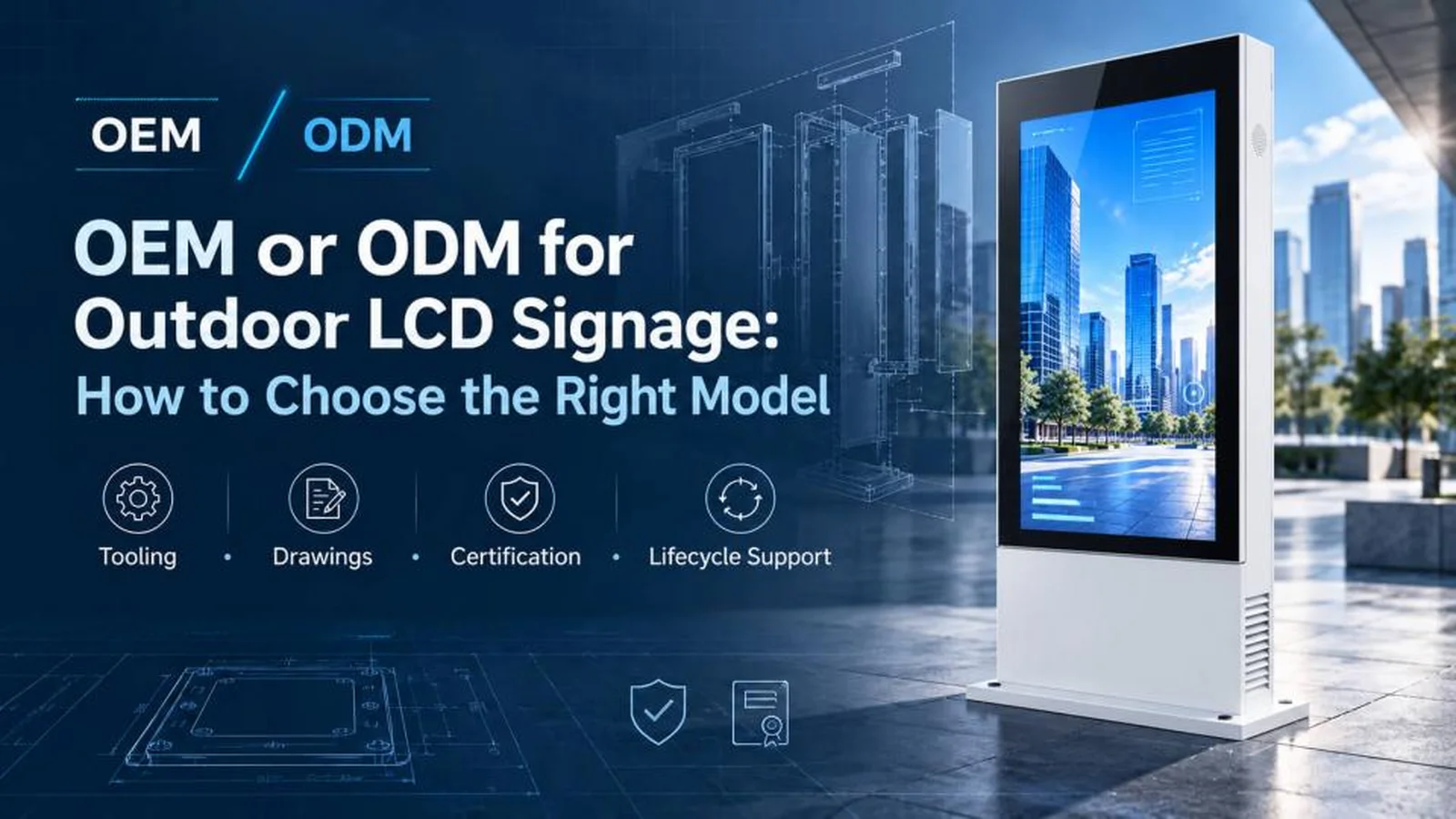
OEM or ODM for Outdoor LCD Signage: How to Choose the Right Model
Site after site, the same question lands on the buyer's desk: should this outdoor LCD programme be built as OEM or ODM? This guide breaks the decision into six variables, covering volume, tooling, IP ownership, certification, firmware and service model, and shows how to specify each one in the RFQ so the quotation states who owns what.
September 16, 2026
 ChatGPT
 Grok
Grok Perplexity
 Claude
OEM and ODM are used almost interchangeably in signage procurement, but the choice decides who owns the tooling, the drawings, the certification and the spare-parts obligation for the life of the deployment. This guide sets out what each model actually involves, when it pays off, and the questions that reveal what a supplier can really deliver.
Key takeaways
- ODM buys speed and a proven platform; OEM buys fit to the site and long-term control over the product.
- The decision should follow site conditions, programme length and compliance requirements — in that order — before the RFQ is issued.
- Tooling, drawings, firmware and the certification holder all need to be named in the quotation, not negotiated after production.
- Asking for a platform bid and a custom bid in the same RFQ quantifies exactly what customisation is worth on your project.
The two models are not interchangeable
Outdoor signage buyers frequently receive quotations that describe the same project as both OEM and ODM, depending on which term sounds more impressive at the time. The distinction is not semantic. It determines who carries the engineering cost, who owns the intellectual property, how long the programme takes to first deployment, and whether the product can still be supported in year seven.
Choosing ODM when the application needs OEM is the more common and the more expensive mistake. It usually looks like a bargain in year one and like an unfixable problem in year three.
What OEM and ODM actually mean in this industry
- ODM — original design manufacturer. The supplier has already designed and tooled a platform. You buy that platform, apply your brand, and select from a defined configuration matrix: screen size, brightness tier, bezel and colour, mounting arrangement, software skin. The engineering has been done and amortised across the supplier's wider customer base.
- OEM — original equipment manufacturer. You specify the product and the supplier builds to your specification. Enclosure geometry, optical stack, interface layout, firmware behaviour and frequently the certification are created or adapted for your programme.
- Semi-custom — the most common reality. A standard platform with programme-specific changes: a different brightness tier, an added sensor, a revised bezel, a locked firmware build, or branding applied at the point of assembly.
Most outdoor signage programmes sit in the third category and get described as OEM. That is where confusion starts, because the commercial and engineering consequences of "some customisation" are very different from those of full custom engineering.
The six variables that decide the model
Six variables determine which model is the right fit. Most of them can be quantified before an RFQ is issued, which is what makes this a commercial decision rather than a matter of preference.
Volume and tooling economics
Tooling is a fixed cost that has to be amortised across a production run. If the expected volume is low, the per-unit cost of a bespoke enclosure rarely justifies itself, and an ODM platform with a modified bezel is the rational choice. The threshold is not a universal number — it depends on enclosure complexity, whether existing tooling can be modified, and how long the programme is expected to run.
The practical test is straightforward: ask what the tooling cost is, who owns it, and how many units it takes for the custom route to beat the platform route on landed cost.
Time to first deployment
ODM is faster because nothing has to be designed. Standard outdoor configurations typically ship in fifteen to thirty working days. An OEM programme adds design review, tooling, first-article inspection and sample approval before volume production can begin — often eight to twelve weeks on top of manufacturing.
If a pilot deployment or a tender deadline is driving the schedule, the model may be decided by the calendar rather than by the specification.
How far your site conditions sit from the platform
This is the single most important technical variable. If the installation is sheltered, in a temperate climate and close to a standard size, a platform product will perform. If the site involves direct sun, coastal salt air, high humidity, a very cold winter or a non-standard mounting geometry, the enclosure, thermal path and optical stack may need to be engineered rather than selected.
Customisation of the outer housing is easy to promise and hard to deliver well. Customisation of the thermal and sealing design is where engineering depth actually shows.
Certification ownership and target markets
Certificates are issued to a named legal entity and cover a tested configuration. In an ODM arrangement, the certificate usually belongs to the supplier and covers the standard product; incremental changes may fall outside its scope. In an OEM programme, the certification position needs to be agreed up front — who holds the certificate, who is named on it, and who pays for retesting when a component changes.
For buyers selling into the European Union, the United Kingdom or North America, this is a commercial question rather than a paperwork question.
Ownership of tooling, drawings and firmware
Ask directly: who owns the enclosure tooling at the end of the programme, and can the drawing package be transferred? In an ODM arrangement, ownership normally stays with the supplier. In an OEM arrangement, it should be negotiated and documented.
Firmware deserves the same treatment. A solution that can only be updated by the original supplier creates a dependency that outlives the warranty. Ask whether the firmware build can be locked to your programme, whether updates are versioned, and whether the update path survives a change of supplier.
Service life and spare-parts continuity
An outdoor network is a multi-year asset. The relevant question is not whether the supplier can ship this year, but whether they can supply a matching replacement unit and the correct spare parts in year seven — and whether the mechanical parts of a custom enclosure remain available after the tooling has stopped running.
Custom enclosures concentrate this risk. The more bespoke the product, the more important it becomes to secure a written spare-parts commitment before production, not after.
When ODM is the right choice
- The installation is sheltered, indoor-facing or in a temperate climate with standard mounting.
- Standard screen sizes are acceptable and the mounting arrangement is conventional.
- Speed matters more than differentiation — a pilot, a tender or a fast rollout.
- The buyer has limited engineering resource and wants a defined, proven product.
- Expected volume per SKU sits below the tooling threshold.
In these conditions, ODM is not a compromise. It is the correct application of someone else's engineering investment, and it is normally the cheaper and faster path.
When OEM is the right choice
- The site demands direct-sun readability, high ambient temperatures, coastal exposure or reliable sub-zero starts.
- The mounting geometry, aspect ratio, enclosure finish or interface layout is genuinely non-standard.
- The programme is a multi-year network where replacements must match the installed base exactly.
- Specific regulatory or client compliance requirements apply that a standard product does not meet.
- Differentiation is a requirement — the product has to be yours, not a re-badged catalog unit.
In these conditions the incremental engineering cost buys something real: a product designed for the conditions it will actually face.
Seven questions that reveal real capability
These questions are useful in either model, because they test whether the supplier can describe its own process rather than its product:
- 1. Who owns the tooling, and can the drawing package be transferred at the end of the programme?
- 2. What is the minimum order quantity for a change to the enclosure, and for a change to the electronics?
- 3. Where is the certification held, in whose name, and which configuration was tested?
- 4. What are the engineering change and sample-approval gates between design freeze and volume production?
- 5. How is the firmware updated in the field, and can the build be locked to our programme?
- 6. What is the spare-parts commitment in years, and what is covered?
- 7. How is the first article inspected, and who signs it off against which measured criteria?
A manufacturer answers these with process detail. A reseller answers them with reassurance. The difference becomes obvious within a single email exchange.
The cost of choosing the wrong model
ODM chosen for an OEM problem. The enclosure looks right in year one. By year three, water ingress has appeared at a gasket that was never designed for the humidity, no matching spare unit exists because the platform has been revised, and the retrofit is impossible because the fixing geometry changed. The savings from year one are consumed by the first site visit.
OEM chosen for an ODM problem. Tooling is paid for, first deployment slips by twelve weeks, and the specification is over-engineered for a sheltered installation that would have been served perfectly by a platform product. The engineering spend produces no measurable benefit.
Both failures come from the same root cause: the model was chosen by habit or by price rather than by site conditions and programme length.
Structuring an RFQ that works for both models
The most reliable way to compare a platform bid against a custom bid is to ask for both, in the same document.
Write the RFQ in two parts. Part one specifies the project requirements — site conditions, duty cycle, brightness target, ingress protection, ambient temperature range, target markets and service expectations — and asks for a platform-based proposal with the closest standard configuration. Part two asks for a custom proposal that meets the requirements without compromise.
The gap between the two proposals is the real cost of customisation for your specific project, and it is a far better basis for a decision than either quotation on its own.
Three conditions should be written into whichever model you choose: a sample-approval gate with measured acceptance criteria, a documented engineering change process, and a clear statement of who owns the tooling, the drawings and the firmware.
For an OEM or ODM programme where spare-parts continuity and drawing ownership matter over a multi-year deployment, it is worth asking a specialist outdoor LCD display manufacturer — MWE (Marvel Technology), for example, which runs both OEM and white-label programmes in-house — to state its tooling ownership and spare-parts position as a written line item in the quotation rather than as a verbal assurance.
FAQ
The questions below are the ones international buyers raise most often when weighing an OEM programme against an ODM platform.
Which is cheaper, OEM or ODM?
ODM is almost always cheaper per unit at low volumes, because the platform's design and tooling costs have already been amortised across other customers. OEM becomes competitive only above the volume at which a bespoke design pays back its tooling — and it can be cheaper in total cost of ownership where the standard platform would have failed early in a harsh environment.
Can one supplier support both OEM and ODM?
Yes, and many specialist manufacturers do. The capability to design and tool a custom enclosure is also what makes a platform product reliable, because the same engineering team develops the thermal path and sealing design. The useful question is not whether a supplier offers both, but whether the specific programme you are discussing falls inside its standard platform matrix or outside it.
Who owns the tooling in an OEM project?
Ownership is negotiable and is usually documented in the supply agreement rather than assumed. Common positions include supplier ownership with a supply commitment, customer ownership with the tooling held on site, and joint ownership with a defined transfer process. What matters is that the position is written down before production begins, together with the drawing package, rather than discussed at the end of the programme.
How do I know whether a supplier really manufactures, or just relabels?
Ask for the point at which engineering changes are frozen, the name of the first-article inspection signatory, and the panel model code that will be used. A manufacturer can answer all three from its own process. A relabeller cannot answer the second at all. The wider verification process is covered in a separate checklist on this topic.
Conclusion
OEM and ODM are not good and bad options; they are different allocations of engineering cost and risk. ODM buys speed and proven design. OEM buys fit to the site and control over the product's long-term behaviour.
The decision should follow the site conditions, the programme length and the compliance requirements — in that order — and should be made before the RFQ is issued, not after the quotations arrive. Buyers who structure the request to include both models get a clear, quantified answer about what customisation is worth for their specific project. Buyers who ask for one model and hope for the best usually discover the answer several years later.
Included In This Story

MARVEL TECH GROUP CO., LTD.
Make Win Easy
MWE manufactures commercial-grade LCD/LED digital signage for retail, QSR, and DOOH applications. Specializing in IP65-rated outdoor displays (2500-5000 nits), indoor video walls, LED poster displays, and Android-based solutions. Regional stock in USA/Germany. Tier-1 components (Samsung, LG, BOE). Built for reliability.
Related Media
Subscribe
Get the latest news and resources from Digital Signage Today.