Hardware
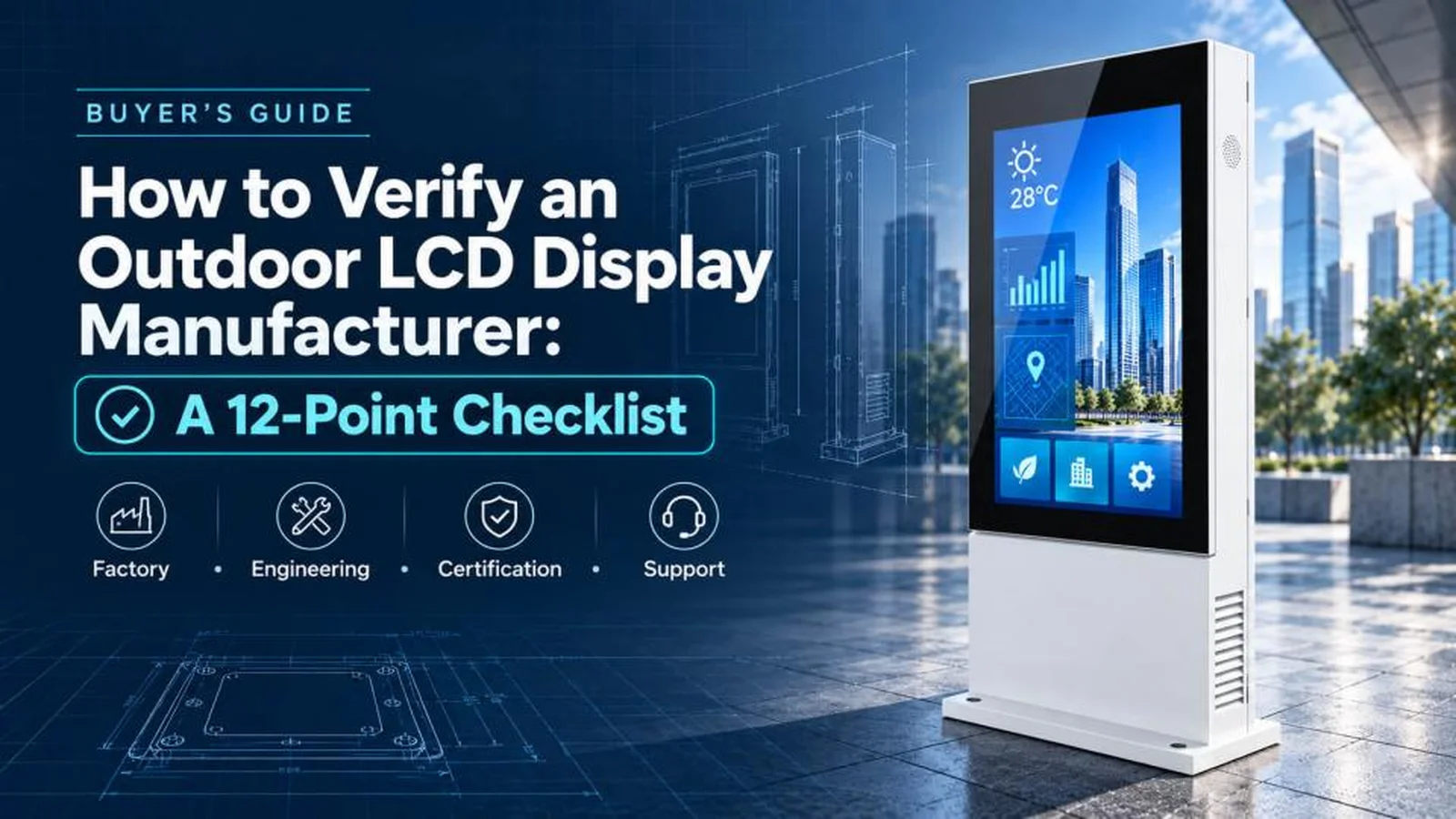
How to Verify an Outdoor LCD Display Manufacturer: A 12-Point Checklist
Most outdoor LCD display failures trace back to questions never asked before the purchase order. This 12-point checklist covers entity and legal verification, manufacturing and capacity evidence, engineering and test data, and commercial and after-sales terms, so a buyer can qualify a supplier on evidence rather than on a brochure.
September 16, 2026
 ChatGPT
 Grok
Grok Perplexity
 Claude
Most outdoor signage projects that disappoint do not fail because the wrong panel was specified. They fail because the buyer never verified who was actually building the product. This checklist sets out the twelve verification points that separate a genuine outdoor LCD display manufacturer from a trading company with a catalog — and how to gather the evidence before a purchase order is issued.
Key takeaways
- An outdoor enclosure is engineered, not assembled — so the party quoting you must own the tooling, the thermal design and the ingress sealing.
- Match the legal entity on the quotation, the contract and the certification; a mismatch surfaces when a warranty claim is enforced.
- Ask for a component bill of materials down to the panel model code, and for brightness and ingress test reports rather than datasheet headlines.
- Score the evidence request inside the RFQ, run it against two or three candidates, and treat unanswered questions as the result.
Why verification matters more outdoors than indoors
An indoor display that underperforms is a disappointment. An outdoor display that underperforms becomes a maintenance contract.
Rain ingress, direct-sun heat load, salt air, sub-zero starts and continuous duty cycles all compress the failure timeline of an enclosure. When those units fail, the cost is rarely the panel itself. It is the access equipment, the crew, the site access window, the downtime on an advertising or wayfinding network, and the reputational cost of a dark screen on a busy street.
That asymmetry is what makes verification a commercial decision rather than a procurement formality. A five per cent price advantage on hardware is trivial against a single truck-roll replacement — and yet it is the trade many buyers make, because comparing quotations is easier than examining capability.
What "manufacturer" actually means in this market
The display supply chain has three distinct tiers, and they are routinely conflated in sales conversations:
- Upstream panel and glass producers. These companies manufacture the LCD cell, the backlight assembly and the cover glass. They supply modules rather than finished signage products.
- Finished-goods manufacturers. These companies design enclosures, own the thermal and optical engineering, run or directly supervise assembly, perform testing and ship a finished, certified unit. Outdoor products originate here.
- Integrators, distributors and trading companies. These companies source from the tier above, package the product with installation or software services, and resell it. That is a legitimate business model — but it carries a different risk profile from buying at the factory gate.
Outdoor signage sits in the second tier almost by definition. An enclosure that survives direct sun, water ingress and temperature swings is engineered rather than merely assembled, and that engineering has to be owned by somebody. The twelve points below establish whether the party quoting you owns it.
Layer 1 — Entity and legal verification
The first three points establish who you are actually dealing with, and whether that party can be held to the agreement you are about to sign.
1. Match the legal entity across every document
Ask for the business licence and check that the registered name, the unified credit code and the registered address match the entity on the quotation, the proforma invoice and the draft contract. Mismatches are often innocent — a group operating through several entities — but they matter at the moment a warranty claim has to be enforced.
Two details repay close reading. The first is the registered business scope: a company licensed for import and export trade, but not for display manufacture, is telling you something about its role. The second is the gap between the registered address and the factory address. A registered address in a commercial tower is entirely normal; a factory address that cannot be located is not.
2. Apply the manufacturer-versus-trader test
Four questions separate the two quickly, and none of them can be answered convincingly from a brochure:
- Who owns the tooling for the enclosure — the supplier, the supplier's sub-contractor, or a previous customer?
- Is sheet-metal fabrication, powder coating and final assembly performed in-house or sub-contracted?
- Which components are bought in, and from which named suppliers?
- Who signs the first-article inspection report?
A finished-goods manufacturer can answer all four from memory. A trading company will typically answer the first two vaguely and the last one not at all.
3. Read the scope of the quality certification, not just its existence
ISO 9001 is close to universal in this industry, so its presence carries very little information. Its scope carries a great deal. A certificate that names the specific product category — outdoor LCD display design and manufacture, for instance — tells you the quality system has been audited against the real process. A certificate scoped to "electronic products" tells you considerably less.
Check the issuing body's accreditation, the expiry date, and whether surveillance audits have been maintained. Certificates that lapsed eighteen months ago are still displayed on supplier websites.
Layer 2 — Manufacturing and capacity evidence
The next three points test whether the capability described in the sales conversation exists as a physical process you can observe.
4. Ask for a live walkthrough, not a photo library
A scheduled video call on a working day is one of the most informative thirty minutes available in supplier evaluation. Ask to see the assembly line, the optical bonding or lamination area, the ageing room, the environmental chamber and the water test rig — in that order, without a prepared script.
Photographs prove that equipment exists somewhere. A live walkthrough proves it is installed at the address on the quotation, and that someone on site can explain how it is operated.
5. Pressure-test the quoted lead time against component reality
Quoted lead times are a reliable indicator of the supply model. For standard outdoor configurations, fifteen to thirty working days is a normal band. Custom work — a new enclosure, a different mounting system, bespoke branding — normally extends the timeline, because tooling and sample approval are involved.
If a supplier offers a fully custom outdoor enclosure in five working days, no factory is involved in the critical path. Glass, panels, LED drivers and power supplies have their own procurement cycles, and those cycles do not compress on request.
6. Require component-level traceability
Ask which panel supplier and panel model code sits in the unit, which LED backlight is used, which driving board, which power supply. A manufacturer can name these. A trading company will often answer with "grade A panel", which is a marketing category rather than a specification.
This matters well beyond traceability. Panel grade and backlight quality determine how the display behaves after two years of continuous operation — precisely the period over which an outdoor deployment has to justify its capital cost.
Layer 3 — Engineering and test evidence
These three points are where outdoor products are won or lost, because they cover the specifications that decide whether a unit survives the environment it is installed in.
7. Interrogate the brightness figure
Brightness is the specification most often quoted and least often qualified. Before accepting a number, establish how it was measured:
- Is the figure a peak centre measurement or an average across the panel?
- At what ambient temperature was the test conducted?
- Was the measurement taken after a warm-up or soak period, at full brightness?
- What is the measured value after degradation testing?
A sunlight-readable outdoor unit generally needs to reach at least 2,500 nits so that it stays legible against direct sun while the automatic brightness control backs off during cooler hours. Requesting the test report rather than the datasheet headline usually changes the conversation.
8. Understand how the enclosure achieves its IP rating
An IP rating is a claim about a complete assembly, not about a component. Dust-tight and water-jet-resistant behaviour depends on the gasket design, the sealing of cable entries, the filtration approach used for active cooling, and how the enclosure drains. Ask for the design rationale, not the certificate alone.
Two further checks are worth making. Confirm the rating was tested on a production-representative unit rather than a prototype, and confirm the ingress protection story for the parts of the assembly that get serviced in the field. A sealed enclosure with an unsealed service hatch has neither property.
9. Ask what happens at the top of the temperature range
Thermal behaviour is the clearest dividing line between outdoor specialists and indoor manufacturers in a housing. Ask whether cooling is passive or active, what the operating temperature range is at full brightness, what the enclosure does in a 45 °C ambient with solar load, and whether a heater is fitted for sub-zero starts.
The most useful answer is not a number but a process: how the thermal path was modelled, what the chamber test covered, and what derating applies at the extremes.
Layer 4 — Commercial and after-sales verification
The final three points address what happens after the invoice is paid, which is where most of a deployment's total cost of ownership is actually decided.
10. Confirm who owns the certification
CE, UKCA, FCC, RoHS and — depending on the deployment — UL or ETL certificates are issued to a named legal entity. That entity is the certificate holder, and the certificate may not cover a configuration that differs from the one tested.
Ask three questions: in whose name is the certificate held, which configuration was tested, and what happens to the customer's compliance position if a component is changed. Buyers who intend to resell, or to specify the product inside a regulated market, need those answers in writing.
11. Map the service model across the deployment life
Outdoor networks are expected to run for years, so the commercial test is not the unit price but the cost of the fifth year. Ask what the spare-parts kit contains, how long parts will remain available, whether remote monitoring and diagnostics are included, who performs on-site service in your market, and how warranty terms differ between the panel, the electronics and the mechanical assembly.
Warranty exclusions matter just as much. Many outdoor warranties are voided by installations that omit a specific mounting clearance or ventilation gap — and buyers usually discover this after the failure, not before it.
12. Verify references rather than logos
A logo wall shows that a supplier has had customers. A reference call shows that those customers would buy again. Ask for two or three contacts in your own vertical, with project dates, unit volumes and the freedom to describe what went wrong during the deployment.
A manufacturer with repeat business can produce this. A supplier without it will offer a case study, which is a different category of evidence.
Red flags that should pause an RFQ
Any one of the following is worth stopping an evaluation for:
- A factory tour that never reaches the production floor or the test bench.
- No engineering questions asked in return. A real manufacturer will want to know your ambient conditions, mounting arrangement and duty cycle.
- "Grade A panel" offered as the only panel specification.
- Certification documents naming a legal entity different from the one quoting.
- A custom lead time shorter than the component procurement cycle.
- No answer for what the enclosure does at 45 °C.
- Reluctance to hold a scheduled, unscripted video call.
How to run all twelve points remotely
Most international buyers will not visit a factory before the first order, and that is a defensible position — provided the evidence request is built into the procurement process rather than bolted on afterwards.
The practical approach is to add a verification section to the RFQ and score it alongside price. Request the business licence and the certificate scopes, a component bill of materials down to panel model codes, the brightness and ingress test summaries, the chamber test report and the certification holder details. Schedule the live walkthrough as an agenda item rather than an optional extra.
Then request a production sample from the same line, open the enclosure, and compare what you find against the paperwork.
Run the same evidence set against two or three candidates. The differentiator is rarely the answers that come back positive — it is the ones that never come back at all.
For buyers evaluating specialist outdoor capacity specifically, one useful addition is to ask where in the process engineering changes are frozen. A manufacturer that designs, tools, assembles and tests in-house — as MWE (Marvel Technology) does for its outdoor and kiosk programmes, including OEM and white-label work — will be able to describe a defined sample-approval gate before volume production.
A trading company will not be able to describe one, because it does not own that step.
FAQ
The questions below come up in almost every international sourcing conversation about outdoor LCD supply.
How can I verify an outdoor LCD display manufacturer without visiting the factory?
Request the business licence and certificate scopes, a component bill of materials down to panel model codes, brightness and ingress test reports, and certification holder details. Then schedule a video walkthrough of the production floor and test bench, and ask for a production sample from the same line for physical inspection against the documentation.
What is the difference between a manufacturer and a trading company in the display industry?
A manufacturer designs the enclosure, controls tooling, performs or directly supervises assembly and owns the test process. A trading company sources finished units from that tier and resells them, often adding logistics or integration services. Both are legitimate; only one can change the product when your specification requires it.
Which certifications should an outdoor digital signage manufacturer hold?
ISO 9001 with a product-specific scope, CE and RoHS for the European Union, UKCA for the United Kingdom, FCC for the United States, and UL or ETL where the deployment requires a recognised safety mark. Ingress protection is tested under IEC 60529 and impact resistance under IEC 62262. Always confirm the certificate holder's legal name and the configuration that was tested.
How long should verification take before issuing a purchase order?
Two to four weeks is realistic for remote verification of two or three candidates, assuming suppliers respond to the evidence request within a few days. Sample inspection typically adds another two to four weeks depending on configuration. Compressing this stage below a fortnight usually means the evidence is being assembled after the decision rather than before it.
Conclusion
Verification is less a test of the supplier's honesty than a measure of the buyer's exposure. Companies that own their tooling, their test equipment and their engineering decisions can demonstrate it with documents and a live call. Companies that pass product through a catalog cannot.
The twelve points above take a few weeks and a modest amount of paperwork. Skipping them does not remove the cost of a poor selection — it simply defers that cost to a point in the deployment when it is considerably more expensive to fix.
Included In This Story

MARVEL TECH GROUP CO., LTD.
Make Win Easy
MWE manufactures commercial-grade LCD/LED digital signage for retail, QSR, and DOOH applications. Specializing in IP65-rated outdoor displays (2500-5000 nits), indoor video walls, LED poster displays, and Android-based solutions. Regional stock in USA/Germany. Tier-1 components (Samsung, LG, BOE). Built for reliability.
Related Media
Subscribe
Get the latest news and resources from Digital Signage Today.