Software
Managing crowds safely and efficiently with dynamic digital signage
Moving large groups smoothly through sports arenas, entertainment venues, airports, and campuses is complicated. With dynamic digital signage, powered by live data, venues can direct crowds, share real-time updates, and enhance the guest experience.
December 4, 2025
 ChatGPT
 Grok
Grok Perplexity
 Claude
Moving large groups smoothly through sports arenas, entertainment venues, airports, and campuses is complicated. These spaces are constantly changing, making safety, crowd control, and efficient operations difficult when using print signs and static screens. With dynamic digital signage, powered by live data, venues can direct crowds, share real-time updates, and enhance the guest experience.
From fixed signs to responsive systems
Static screens or printed signs are great for messages that aren’t time-sensitive or change often. Updating them is time-consuming and expensive. If a change happens—like a broken elevator, a gate switch, or a long line—static signs can't keep up.
Dynamic digital signage uses real-time information to adapt. For example, after an event ends at a large arena, sensors detect congestion at a gate. Screens immediately share updated information to direct people to other exits. Additionally, screens inside and outside the venue can display real-time shuttle and transit information.
In airports, screens provide real-time updates on flights, delays, or gate changes. While in convention centers, crowd data guides traffic from full sessions to overflow spaces. In any situation, digital signage is crucial for safety and traffic flow.
Why crowd management matters
Crowd management boosts safety, efficiency, and satisfaction. Without it, the risk of congestion and incidents rises. Stadium bottlenecks, airport delays, and crowded conventions require real-time coordination. Staff alone cannot solve these problems. By connecting digital signage to occupancy, ticketing, or transportation data, facilities can monitor crowds and redirect people before issues arise.
Elevating the guest experience
Reducing confusion and stress in large venues directly impacts guest satisfaction. Sharing relevant, real-time information helps create a safer, guest-focused experience.
At a convention center, digital signage can be used to welcome attendees and display live updates of sessions in progress. It can direct people to rooms with available seating or, as sessions end, guide them toward networking areas or food courts. This process helps avoid hallway congestion.
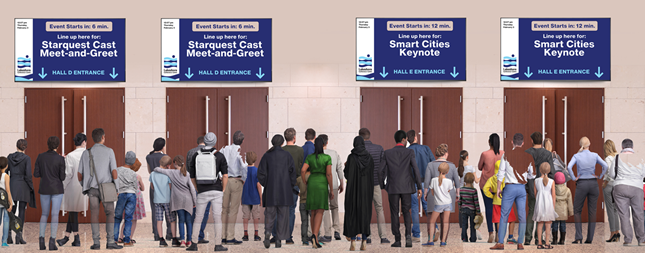
In airports, screens near security checkpoints share estimated wait times. Gate-area displays show real-time information on flight delays or gate reassignments. Information finds travelers where they are, eliminating the need to hunt for updates.
On a university campus, digital displays guide students to events, announce class cancellations or room changes, and deliver emergency alerts.
Design that moves people
The placement and design of digital signage is key to guiding crowds effectively through large venues. Position displays where pathways converge—near escalators, exits, and intersections. In stadiums and arenas, place digital signs above the crowd. This ensures messages are not blocked by movement.
Use clear, well-placed messages at decision points. Technology alone doesn't manage crowds. Messaging should be concise and use a visual hierarchy with standard icons. In emergencies, color and motion get attention and break through distractions.
When design and technology work together, screens guide people intuitively—eliminating the need to seek directions or decipher complex maps.
Safety through real-time responsiveness
In fast-changing situations, communication must be instant and precise. This saves lives.
Dynamic signage enables automated, visual communication. It reaches everyone, even in noisy or chaotic environments. If an alarm triggers, screens throughout the facility or in a specific area immediately bypass scheduled content. They display critical information such as evacuation routes and emergency exits. Screens provide location-specific instructions, replacing generic alerts.
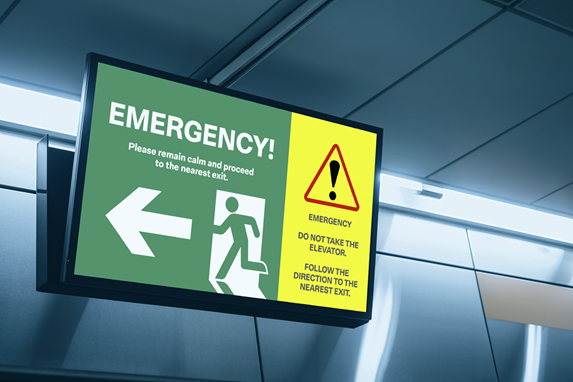
Additionally, visual signage helps overcome language barriers and assists guests who are hearing impaired. Live data ensures each area receives timely and relevant instructions.
The advantage of digital signage software
The key to having real-time responsiveness is a digital signage software platform, like Omnivex. With Omnivex digital signage software, organizations can connect their screens to almost any data source— sensors, APIs, ERP, CRM, or security systems. This creates real-time, actionable communication and delivers consistent messages across screens in various venues. By uniting data, communication, and automation, Omnivex enables venues to proactively manage crowds, enhance safety, and improve operations far beyond static signage or traditional digital displays.
The future of crowd management
The future of crowd management is intelligent environments—spaces that adapt to people. Screens become a dynamic interface between people and infrastructure. They deliver timely, data-driven messages to keep people safe and informed. Crowd intelligence shifts management from reactive to proactive. Dynamic signage is the bridge that enables this.
In every crowded space—stadium, terminal, or campus quad—information is more than power. It's safety, trust, and connection.
Stadiums / ArenasContent ManagementEntertainment VenuesTransportationSoftwareCustomer ExperienceContentOmnivex
Included In This Story

Omnivex
Omnivex digital signage software enables organizations to collect, present, and share information in real-time, on any screen.
Request Info
Learn MoreRelated Media
Subscribe
Get the latest news and resources from Digital Signage Today.