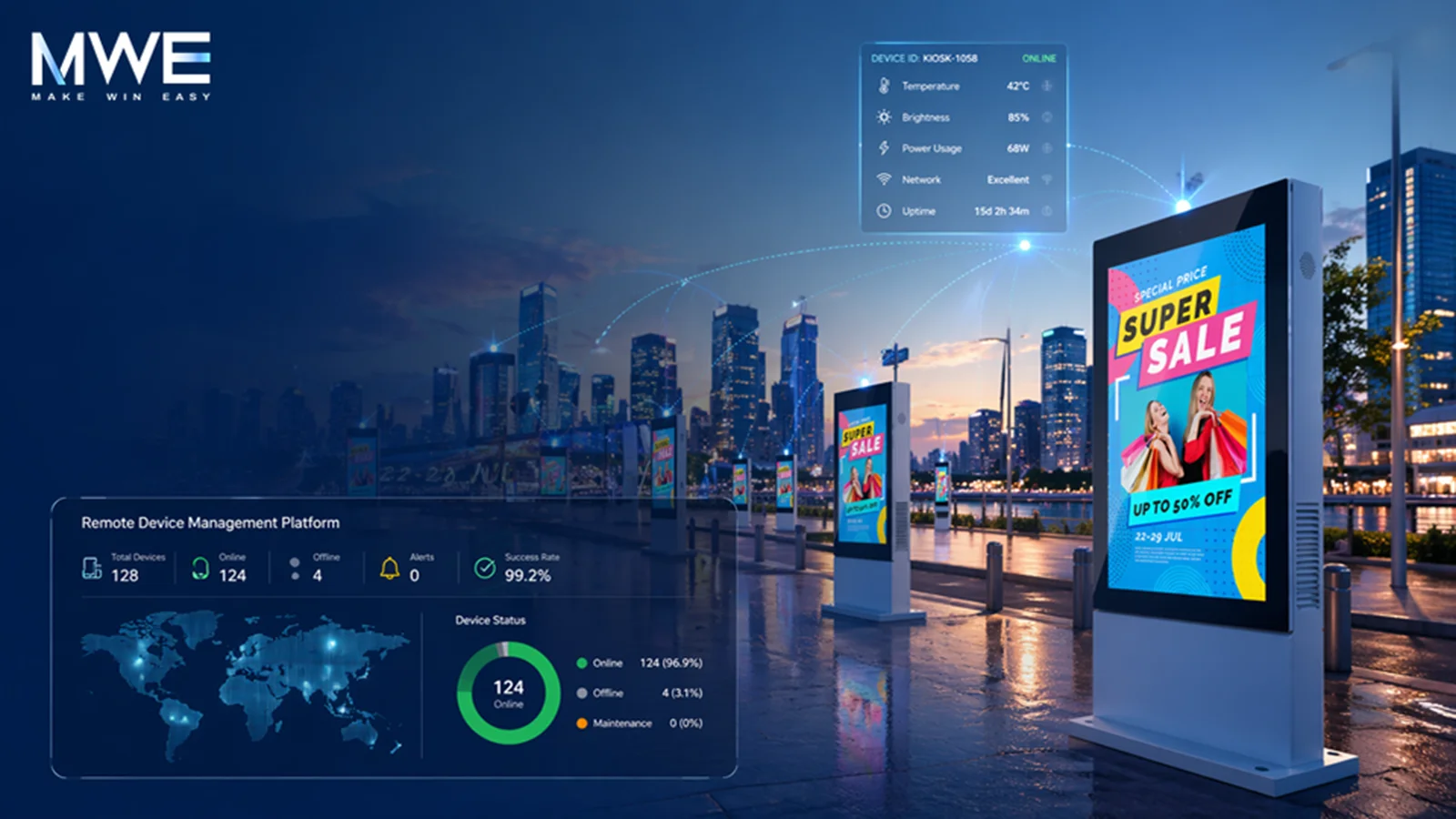
For operators managing 50, 500, or 50,000 screens, the real cost isn't the hardware. It's what happens after the hardware is installed.
Remote Device Management (RDM)refers to IoT-based platforms that continuously monitor, diagnose, and maintain deployed hardware fleets in real time — enabling operators to shift from reactive field service to predictive, data-driven operations at scale. In large-scale digital signage, RDM is rapidly becoming the dividing line between networks that scale profitably and those that bleed money post-deployment.
The Uncomfortable Truth About "Deploy and Forget"
The digital signage industry has spent years perfecting the hardware — higher brightness, thinner bezels, better weatherproofing. But there's an elephant in the room that most manufacturers don't talk about:
Post-deployment operations eat up 60–70% of the total cost of ownership (TCO) over a product's lifecycle.
According to MediaSignage's 2026 industry benchmark, hardware accounts for only 30–40% of 5-year TCO, while software, content, maintenance, and connectivity collectively consume the remaining 60–70%.
Think about it. You deploy 1,000 outdoor LCD displays across a city for a DOOH network. The purchase price? That's a one-time hit. But for the next 5–7 years, you're paying for:
- Truck rolls every time a screen goes dark
- Technicians diagnosing problems on-site that could have been caught remotely
- Energy waste from displays running at full brightness at 2 AM
- Premature hardware replacements because nobody caught the overheating fan
- Customer SLA penalties when uptime drops below contract thresholds
This is where Remote Device Management (RDM) flips the equation.
What RDM Actually Does (Beyond "Remote Control")
Let's be precise. RDM is not a fancy remote desktop. It's not just "turning screens on and off from your phone." A mature RDM system is an IoT-driven operational intelligence layer that sits between your hardware fleet and your operations team.
At its core, a well-architected RDM system provides:
1. Real-Time Environmental & Hardware Telemetry
Outdoor commercial displays operate in hostile environments — direct sunlight, rain, dust, temperature swings from -20°C to 60°C. A serious RDM system ingests data from 12+ physical sensors per device:
- Internal and external temperature
- Humidity levels
- Ambient light (for adaptive brightness)
- Fan speed and airflow status
- Power supply voltage and current
- Door/enclosure tamper detection
- Network connectivity quality
This isn't data for data's sake. Each sensor stream feeds into automated threshold rules — if internal temperature exceeds 55°C, the system can reduce brightness, activate auxiliary cooling, or alert the operations team before the panel sustains damage.

2. Predictive Maintenance, Not Reactive Firefighting
Here's where the cost savings become tangible.
Traditional maintenance is reactive:
Something breaks → you send a technician → they diagnose → they order parts → they return to fix it. Two truck rolls, days of downtime, and an unhappy client.
RDM enables a predictive model:
Sensor trend analysis flags a cooling fan that's gradually losing RPM. The system generates a maintenance ticket weeks before failure. A technician visits once, with the right part, during a scheduled window. One truck roll. Zero unplanned downtime.
In large-scale deployments (10,000+ screens), this shift from reactive to predictive maintenance alone can reduce field service costs by 30–40% — a figure consistent with Mordor Intelligence's 2025 Digital Signage Services Market report, which found that maintenance and support services account for 44.1% of the market's revenue, underscoring how dominant (and reducible) this cost center is.
Real-world scenario: A DOOH operator in the Middle East deploys 2,000 outdoor kiosks rated for 3,000 nits across Saudi Arabia and the UAE, where ambient temperatures regularly exceed 45°C. Without RDM, thermal damage to backlight units would be the leading cause of premature failure. With sensor-driven thermal management — automatic brightness reduction at critical thresholds, proactive fan replacement alerts — the same fleet maintains 98%+ uptime through its third summer without a single heat-related panel replacement.
3. Intelligent Energy Management
Outdoor displays are power-hungry — a 75-inch high-brightness outdoor LCD can draw 800W–1,200W at peak. Multiply that by thousands of units running 18 hours a day.
RDM systems with ambient light sensors enable adaptive brightness scheduling: screens automatically dim during cloudy conditions or low-traffic nighttime hours, then ramp up in direct sunlight. This isn't just about saving electricity — it directly extends backlight lifespan and reduces thermal stress on components.
Operators consistently report 15–25% energy savings after implementing intelligent brightness management across their fleets. Auto-brightness sensors — now standard in professional outdoor displays from Samsung VXT, LG XE4F series, and MWE outdoor lines — dynamically match output to ambient conditions, often cutting peak power draw by a third during overcast or nighttime hours.
For a Scandinavian transit authority running 800 outdoor LCD totems across Norway and Sweden, this translated to approximately €140,000 in annual electricity savings — enough to fund the RDM platform subscription and a full-time remote operations engineer, with budget left over.
4. Remote Diagnostics & Recovery
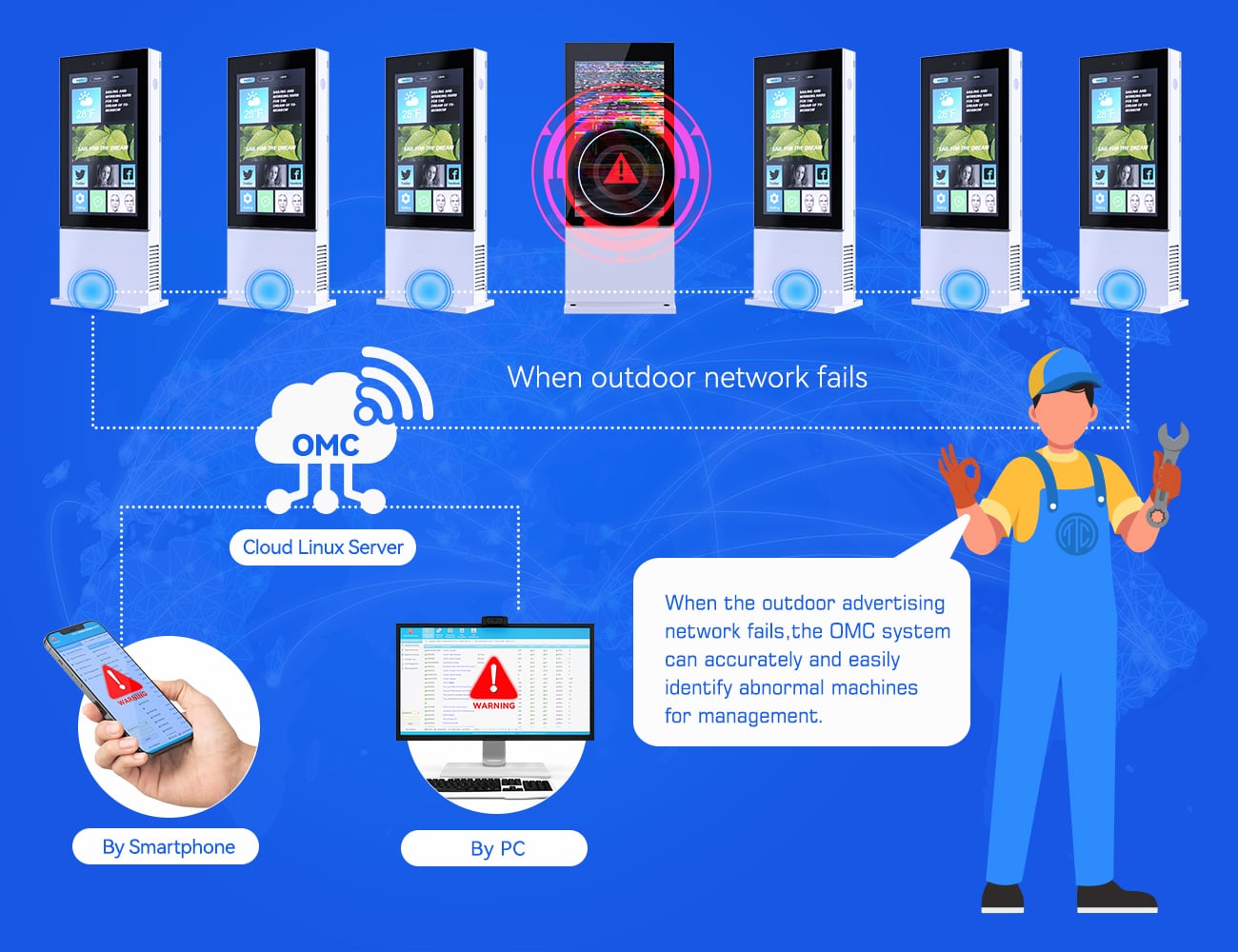
When something does go wrong, RDM compresses the resolution cycle:
- Remote reboot resolves ~40% of field issues without dispatching anyone
- Log and screenshot capture lets engineers diagnose the remaining issues remotely
- Firmware OTA (over-the-air) updates patch software bugs across entire fleets in hours, not weeks
- Network failover management switches between primary and backup connectivity automatically
Every avoided truck roll saves $150–$500 depending on geography (based on CrownTV's multi-location deployment cost analysis). At fleet scale, this compounds into serious money.
The Numbers: Why Large Operators Can't Afford to Skip RDM
Let's run a simplified model for a 5,000-screen outdoor DOOH network over a 5-year lifecycle:
Estimates derived from MWE's internal deployment data across 50,000+ managed outdoor devices, cross-referenced with MediaSignage's 2026 TCO benchmarks and Mordor Intelligence's Digital Signage Services Market Report. Actual savings vary by geography, climate conditions, and network configuration.
The takeaway: RDM doesn't cost money. The absence of RDM costs money.
Why Most Manufacturers Don't Talk About This
Here's the uncomfortable industry truth: most digital signage manufacturers are hardware companies. They make money when you buy screens. They don't have a strong incentive to help you operate those screens efficiently for the next 7 years.
Building a real RDM system requires a fundamentally different DNA — you need embedded firmware engineers, IoT platform architects, cloud infrastructure, and years of real-world deployment data to tune your sensor thresholds and prediction models. It's telling that Mordor Intelligence's market analysis identifies maintenance and support as the single largest service segment at 44.1% of revenue — yet the vast majority of hardware vendors outsource or ignore this entirely.
At MWE, we started building our RDM system not because it was a nice product feature, but because we had to. When you've shipped outdoor displays to 150+ countries — from the deserts of Saudi Arabia to Scandinavian winters — you learn very quickly that hardware alone doesn't survive. The system around the hardware is what makes or breaks a deployment.
Today, our RDM platform actively manages approximately 50,000 outdoor LCD devices globally. Every anomaly pattern, every failure mode, every climate-specific insight feeds back into both our software algorithms and our hardware design decisions. It's a flywheel that's been spinning for over a decade.
What to Look for in an RDM Solution
Whether you're evaluating MWE or any other vendor, here's a practical checklist:
- Sensor depth: How many physical sensors per device? Anything below 8 is insufficient for serious outdoor deployments.
- Alerting intelligence: Does it just send alerts, or does it correlate sensor data to predict failures?
- Fleet-wide OTA: Can you push firmware updates to 10,000 devices simultaneously without manual intervention?
- API openness: Can the RDM data integrate with your existing NOC (Network Operations Center) or ITSM tools?
- Track record: How many devices are actively managed on the platform? Theoretical capability and battle-tested scale are very different things.
- Lifecycle alignment: Is the RDM provider also the hardware manufacturer? Tight hardware-software integration yields better sensor calibration and more accurate predictions.
The Bottom Line
Digital signage is maturing as an industry. The conversation is shifting from "what resolution and brightness do I need?" to "what's my total cost of ownership over 7 years, and how do I keep 99.5% uptime across 10,000 screens?"
RDM is the answer to that question. Not as a nice-to-have feature. As the single most impactful lever on long-term operational economics.
The manufacturers who understand this — who invest as heavily in operational intelligence as they do in panel technology — are the ones building the next generation of commercial display infrastructure.
The rest are just selling screens.
MWE (Make Win Easy) is the hardware brand of Marvel Tech Group Co., Ltd., a commercial display and interactive imaging manufacturer established in 2008. Learn more at mwedisplay.com.