DOOH Advertising
Outdoor Drive-Thru Digital Signage: From Static Menu Board to Revenue Engine
Drive-thru digital signage is turning static menu boards into dynamic revenue tools. This article explains how dayparting, weather-responsive promotions, inventory-aware menus, AI personalization, and POS integration can improve order value, speed service, reduce menu-change costs, and deliver measurable ROI for QSR operators.
August 7, 2026
 ChatGPT
 Grok
Grok Perplexity
 Claude
The drive-thru lane is where quick-service restaurants make or lose their day. With drive-thru sales accounting for up to 70% of QSR revenue, operators are swapping static vinyl menu boards for dynamic digital displays — and early deployment data shows the move pays for itself in well under a year.
The drive-thru has never been just a window — it is the most profitable operational zone in quick-service restaurants (QSRs), generating the majority of revenue at many chains. But for decades, the physical menu board was the least adaptable part of that zone: a printed vinyl panel, changed by hand every few months, incapable of responding to the time of day, the weather, or the inventory sitting in the kitchen.
Digital signage changes that calculus. What was once a static board is now a data-driven selling platform that updates in real time, upsells at the point of decision, and eliminates the operational drag of manual menu management. For integrators and restaurant operators alike, the drive-thru has become one of the clearest ROI stories in the industry.
The Dayparting Dividend
The most immediately valuable capability of a digital drive-thru menu board is dayparting — the automatic shift of content by time of day. Breakfast switches to lunch at 10:30 AM without a crew member touching a screen; a late-night value menu activates after 10 PM to capture the closing shift. That alone eliminates a constant, error-prone manual chore.
From there, the triggers multiply:
- Weather-responsive promotions. Hot coffee leads on cold mornings; frozen treats surface when the thermometer crosses 25°C. No forecast meetings required — the CMS just reads the weather feed.
- Inventory-aware selling. When an ingredient runs low, the system removes the affected item from the board before a customer ever orders it, preventing the most common source of drive-thru friction: the order refusal at the window.
- Instant limited-time offer management. LTOs launch and retire in minutes, without print runs, shipping delays, or a crew member taped to a ladder.
The common thread: the menu board stops being content and starts being a system that reacts to the business around it.
The AI Wave — With a Reality Check
The next generation of drive-thru displays is adding intelligence at the edge. Vehicle detection identifies the type of car in the lane and adjusts suggested items; anonymous demographic sensing estimates the occupants' profile and tailors what appears on screen; loyalty-program integration pulls order history to surface personalized recommendations.
This is genuinely promising — and genuinely worth a caution. Anonymous sensing must stay anonymous, and operators deploying AI-driven personalization should work with partners that take privacy and data governance seriously. The good news for budget-conscious operators: AI is an accelerator, not a prerequisite. A well-configured dayparting and weather-triggered deployment delivers strong ROI on its own, and AI layers can be added later without ripping out hardware.
The Numbers That Matter
The ROI case is what's moving this market. Across deployments tracked by industry data, dynamic upselling and suggestive selling typically lift average order value by 12–18%, while faster decision-making at the board improves drive-thru throughput by 15–20%. Customer satisfaction scores climb as relevant promotions replace stale static boards and out-of-stock items disappear from view. Meanwhile, menu change costs drop by roughly 90% once digital updates replace printed board replacement.
A 120-location QSR chain that deployed AI-enabled drive-thru signage reported a 12% increase in average order value and an 18% throughput improvement over 12 months — with the deployment reaching payback in seven months. At typical price points, operators should plan on ROI in the six-to-eight-month range.
Spec It Right the First Time
Drive-thrus are among the harshest environments in retail signage, which is why hardware spec matters more than flash. The checklist that separates a five-year deployment from a warranty claim:
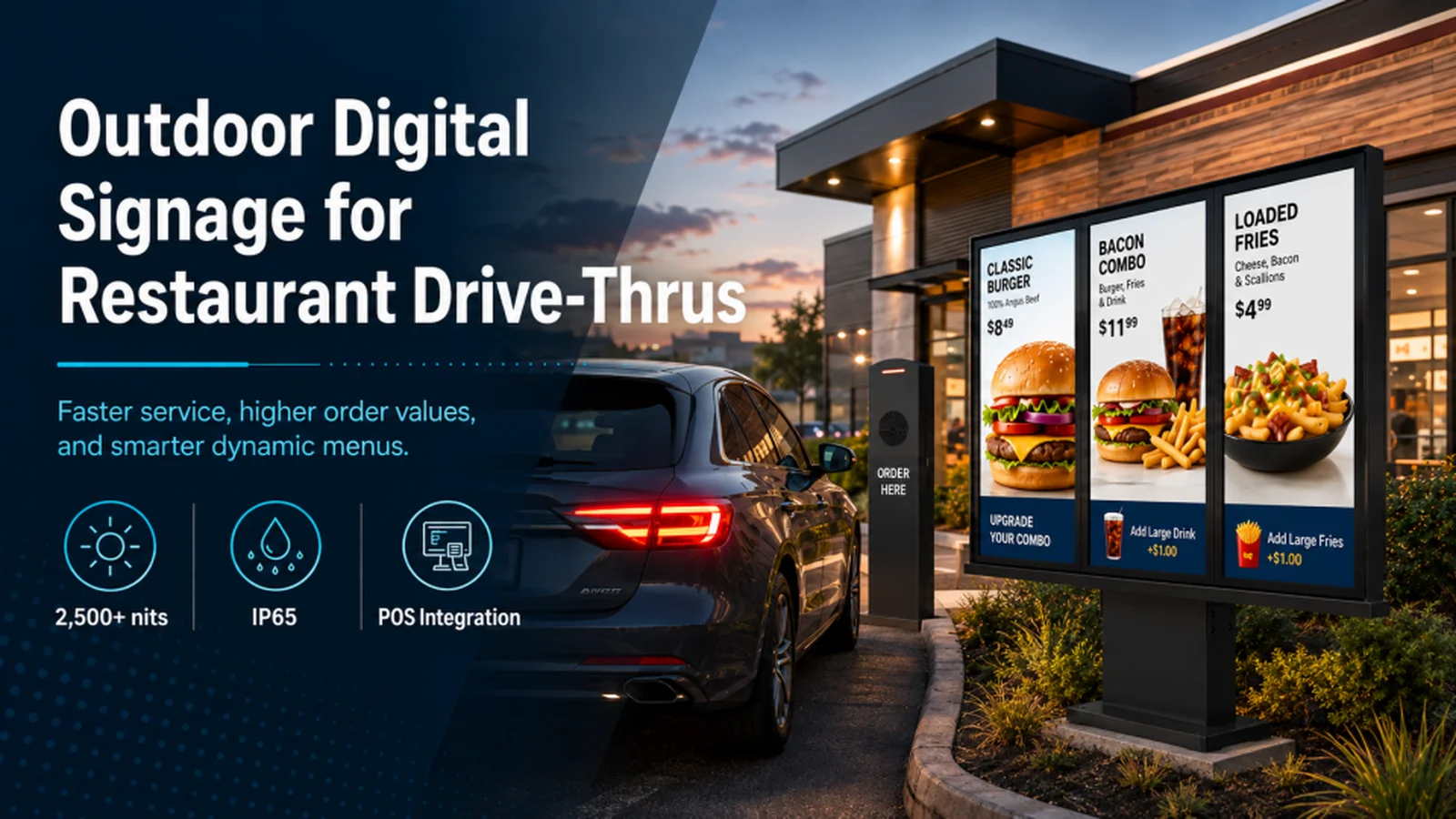
- Brightness: 2,500–3,500 nits for readability in direct sunlight — non-negotiable for outdoor-facing boards.
- Size: 32–55 inches for the primary menu board; 15–22 inches for the order-confirmation display at the window.
- Environmental rating: IP65 minimum, since lanes face rain, snow, and regular wash-down.
- Operating temperature: -30°C to +50°C for dependable year-round operation across climates.
- Optical bonding: essential for anti-fog and anti-glare performance in changing light and weather.
- POS integration: real-time inventory sync prevents selling items the kitchen can't produce — arguably the highest-leverage software feature of all.
Cost of Entry
Deployment economics are well within reach for independent operators, not just chains. Expect roughly 3,000–8,000 per drive-thru lane for display, media player, and CMS, with ongoing CMS subscription costs of 50–200 per month. Most modern POS systems — including widely used platforms like Square, Toast, and NCR — support API integration with signage CMS platforms, so the data connection is rarely the hard part.
What's Next
The drive-thru board is becoming a node in a larger operational network. Expect to see predictive demand management — where signage content aligns with forecasted order volume and staffing — and deeper integration of edge AI as hardware costs fall. The physical lane itself is also evolving, with pickup windows for delivery drivers and mobile-order customers creating new touchpoints for confirmation and upsell displays.
For an industry whose most profitable few square feet have been static for decades, the direction is clear: the menu board is no longer something to print. It's something to program.
Article adapted from MWE Tech LCD's industry research for Digital Signage Today. For specifications on rugged outdoor displays purpose-built for drive-thru environments, contact the MWE (Marvel Technology) promotion team.
Included In This Story

MARVEL TECH GROUP CO., LTD.
Make Win Easy
MWE manufactures commercial-grade LCD/LED digital signage for retail, QSR, and DOOH applications. Specializing in IP65-rated outdoor displays (2500-5000 nits), indoor video walls, LED poster displays, and Android-based solutions. Regional stock in USA/Germany. Tier-1 components (Samsung, LG, BOE). Built for reliability.
Related Media
Subscribe
Get the latest news and resources from Digital Signage Today.